How to Choose a Garden Arbor for Your Backyard
A garden arbor is the gateway you walk through; a trellis is the flat panel a climbing plant grows against. I’ve built both, bought both, and watched a cheap one fold up in a windstorm, so I can tell you the difference between a structure that lasts fifteen years and one that lasts fifteen months usually comes down to two decisions you make before you spend a dime: what the structure is supposed to do, and what it’s made of. Here’s how I’d walk a friend through choosing a garden arbor or trellis — style, materials, building your own, planting it, and keeping it standing.
As an Amazon Associate, Backyard Superstar earns from qualifying purchases at no extra cost to you.
What an Arbor Does (and What It Doesn’t)
An arbor earns its spot in a yard three ways. It gives climbing plants — roses, clematis, wisteria, honeysuckle — the vertical structure they need. It defines space: an arbor at the entrance to a vegetable garden marks a threshold, and a trellis along the side of a deck creates enclosure without a wall. And it adds height, which is the cheapest trick going for making a flat yard feel bigger, because the eye finally has somewhere to go.
What an arbor is not is a pergola or a gazebo. A pergola is a bigger overhead structure that shades a seating area; a gazebo is fully roofed. An arbor is narrower — usually 3 to 5 feet wide — and it’s meant to be walked through or stood near, not sat under. If what you actually want is shade over a patio table, save yourself the disappointment and look at budget-friendly pergola designs instead. I’ve seen more than one arbor bought for a job a pergola should have done.
So before anything else, answer one question: are you supporting a single climbing plant, framing a pathway, or building privacy? Each answer points at a different structure and a different price tier — a wall trellis sits at the $ end, a walk-through arbor in the $$ middle, and a full-size cedar or vinyl arbor with real presence up at $$$. Pick the job before the material.

Picking the Right Style, Size, and Material
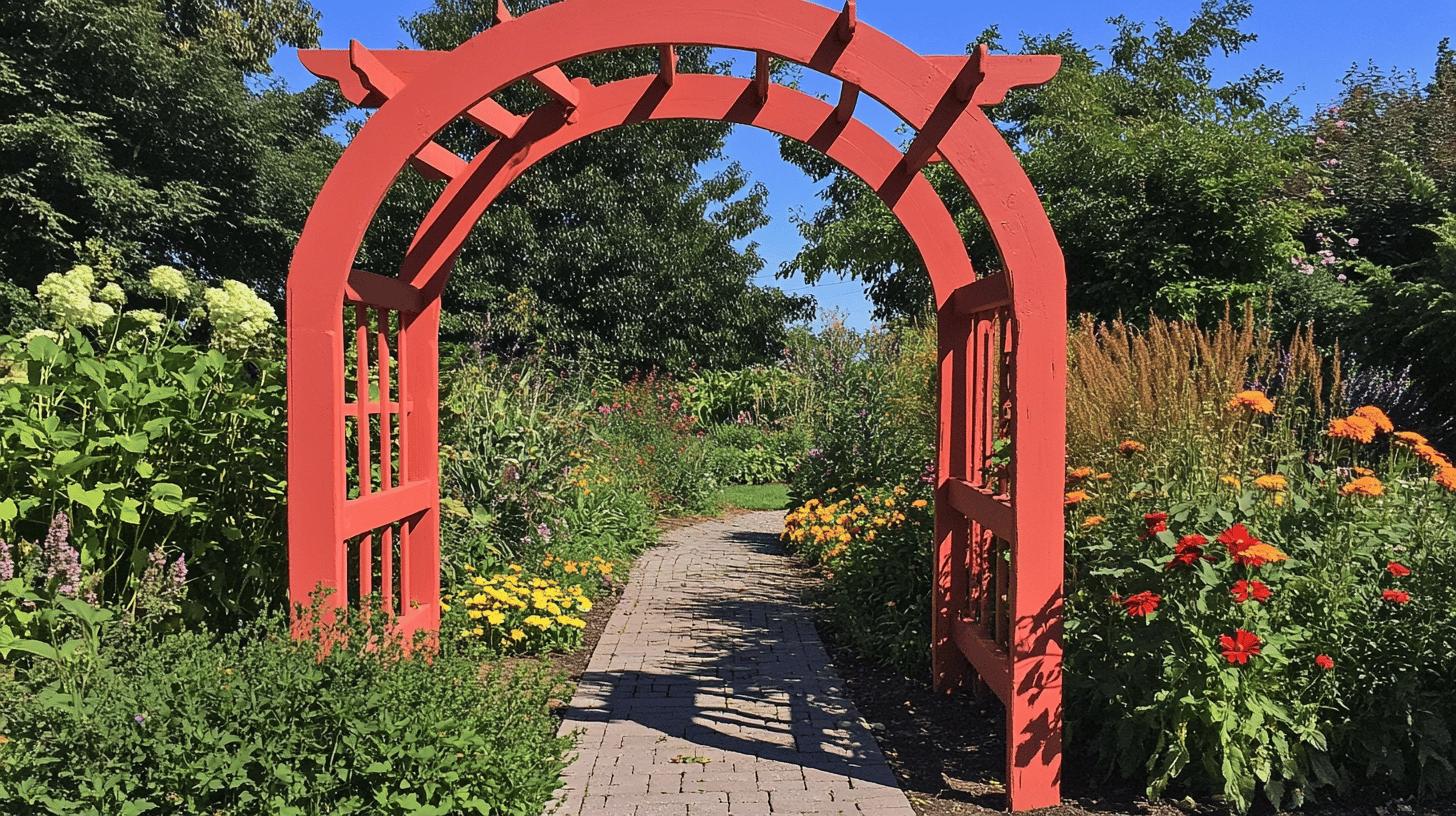
Style is mostly about matching what’s already there. Painted white wood with a curved arch reads cottage. Powder-coated black metal reads modern. Natural cedar reads rustic. Wrought iron reads formal English garden. The mistake I see is buying the arbor you liked in the photo instead of the one that matches your fence and house — a black modern arch in front of a white picket fence looks like it wandered into the wrong yard.
Size has a hard floor. A walk-through arbor needs to be at least 7 feet tall at the peak and about 3.5 feet wide inside, or it stops being a gateway and starts being a duck-under. And plan for the mature size of the plant, not the nursery pot: wisteria reaches 25 feet, clematis tops out around 12, and most climbing roses run 8 to 12. That’s why I like taller steel arches such as the Best Choice Products 92-inch steel garden arch ($$) as a first arbor — it’s a true 7-foot-8 at the peak, the wire lattice gives young climbers something to grab immediately, and it assembles in well under an hour with one wrench. That’s the one I’d hand most beginners.
Material is where the long-term cost hides, so here’s the honest comparison:
| Material | Typical lifespan | Maintenance | Price tier | The catch |
|---|---|---|---|---|
| Cedar / redwood | 10–15 years unsealed | Optional sealing every 2–3 years | $$–$$$ | Costs more up front; grays if you don’t seal it |
| Pressure-treated pine | ~10 years | Annual sealing in wet climates | $–$$ | Skip the sealing and it rots at the soil line |
| Powder-coated steel / aluminum | 15–20+ years | Near zero | $–$$ | Budget versions flex under heavy vines |
| Vinyl | 15+ years | None | $$$ | Looks plastic up close; brittle in hard-freeze climates |
If you want wood without milling lumber yourself, the Giantex 85-inch wooden garden arch ($$) is a straightforward kit — fir frame, classic arched profile, and an easy afternoon assembly. It will want a coat of outdoor sealer before the first winter, because the factory finish alone won’t carry it through freeze-thaw cycles. On the other end, if maintenance is the thing you’re buying your way out of, a vinyl unit like the Vita Florence 49-by-94-inch vinyl arbor ($$$) never needs sealing or paint. I’ll be straight with you: up close, vinyl looks like vinyl. But it’s the only material here you can genuinely install and ignore for a decade, and against white cottage trim it photographs beautifully.
One visual rule that has never steered me wrong: if your yard is all straight lines — rectangular beds, square patio, board fence — one arched element softens the whole picture. If the yard is already curves and billowing borders, a flat-topped trellis adds the contrast instead.

DIY: Building Your Own Arbor or Trellis
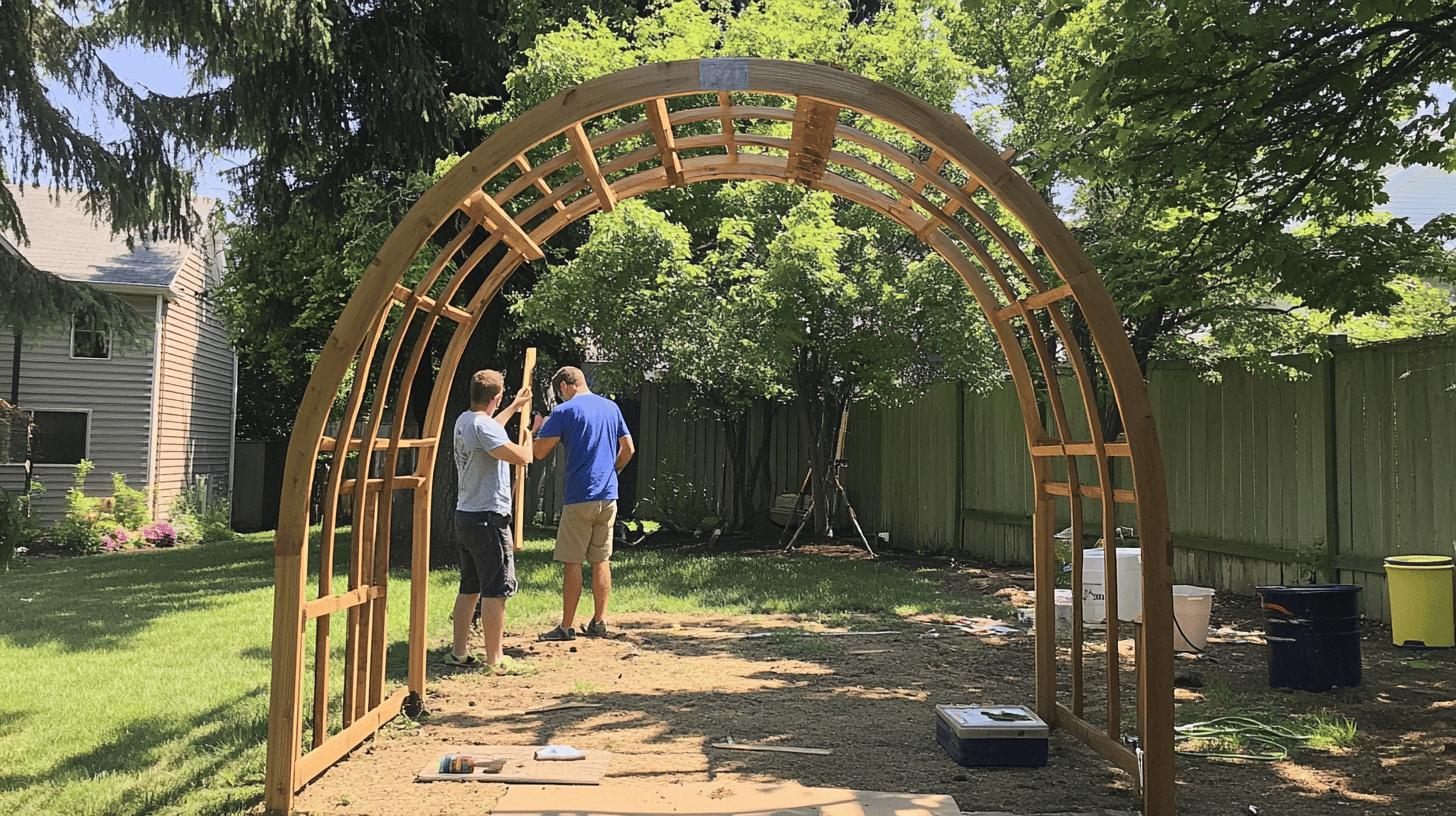
Building your own is genuinely cheaper than buying — usually a fraction of the cost of a comparable pre-built unit — and you get to size it to your yard instead of the other way around. The build I recommend to everyone, and the one standing in my own side yard going on four summers now, uses a livestock panel: a standard 16-foot cattle panel from a farm-supply store, bent into an arch between two pairs of posts. It goes up in an afternoon and it’s strong enough for any climbing plant you’d realistically throw at it, wisteria included.
What you’ll need for a 4-foot-wide, 7-foot-tall arched arbor:
- 1 cattle panel (16 ft × 4 ft — sold as “cattle panel” or “hog panel”)
- 4 pressure-treated 4×4 posts, 8 feet long
- 4 bags of quick-set concrete
- Heavy-duty stainless or UV-rated zip ties ($), or stainless wire
- Optional: 1×4 boards for a trim board across the top
Tools: post-hole digger, circular saw, drill, level, tape measure, and work gloves — the cut ends of a cattle panel are razor-sharp, and I have the scar to prove that glove advice is earned.
- Set the posts. Mark four post locations in a 4×3-foot rectangle. Dig 2 feet deep, drop in the 4×4s, brace, check level on two faces, pour the quick-set. Let it cure overnight — don’t rush this one.
- Bend the panel. With a helper, plant one short end at the base of the front posts and walk the other end toward the back pair. The panel arches itself overhead. Center the peak.
- Attach it. Zip-tie or wire the panel to each post at three or four points per post. Done properly this takes ten minutes.
- Trim and seal. A 1×4 across the front top hides the panel ends. Two coats of outdoor sealer on the posts, a week apart, roughly doubles their life; skip it only if you sprang for cedar.
A flat wall trellis is even easier — 1×2 cedar boards in a lattice grid on wall brackets, one Saturday morning, materials at the bottom of the $ tier. And if you like building with reclaimed wood, the bracket-and-screw techniques in our garden hammock frame plans for pallet wood carry straight over to arbor frames with lighter loads.
Three things first-timers underestimate, because I underestimated all three: posts go in concrete, not packed dirt, since a vine-covered arbor is a sail and the first real storm will tip a dirt-set one; the gloves are not optional; and build taller than feels necessary, because 7 feet sounds generous right up until a climbing rose is hanging through the panel at forehead height.

The Best Climbing Plants for Arbors and Trellises
The plant decides the rest of the story — what the structure looks like in June, how much pruning you sign up for, and how beefy the frame has to be. Climbing roses are the classic, and the repeat-blooming cultivars (Eden, Zéphirine Drouhin, New Dawn) are the ones worth planting; the old one-bloom heirlooms give you two spectacular weeks and fifty quiet ones. Full sun, 8 to 12 feet of reach, happy on a basic arbor.
Clematis is the cool-climate workhorse, with more colors than roses and a famous rule — feet in the shade, head in the sun — that really does matter. Henryi in white, Jackmanii in purple, and Nelly Moser in pink are the reliable starters. Native trumpet honeysuckle (Lonicera sempervirens) is the one I plant when someone wants fast, fragrant, and hummingbirds; just don’t let a nursery talk you into invasive Japanese honeysuckle, which will eat the fence, the arbor, and the neighbor’s shed.
Wisteria deserves its own paragraph and its own warning. In bloom it’s the most dramatic thing you can grow in a backyard, and at maturity it weighs hundreds of pounds and pulls weak structures apart like wet cardboard. Plant it only on serious framing — 6×6 posts, a cattle-panel build, or a purpose-built unit like this heavy-duty 55-by-87-inch metal garden arch with an enlarged base ($$), which is built with wider footing plates exactly so vine load doesn’t rack it. American wisteria (Wisteria frutescens) is the better-behaved native; the Asian species are the ones in the horror stories. And if you want flowers this summer without commitment, morning glory direct-sown in spring blooms by July and dies politely at frost — a good one-season test drive before you plant something permanent.
For cultivar-by-cultivar guidance, our roundup of the best climbing plants for vertical gardens goes deeper than I can here. Wherever you land, dig the planting hole 12 to 18 inches out from the post rather than against it, and lean the plant toward the structure — roots don’t love concrete footings, and the angled stem finds the frame on its own.

Maintenance Through the Seasons
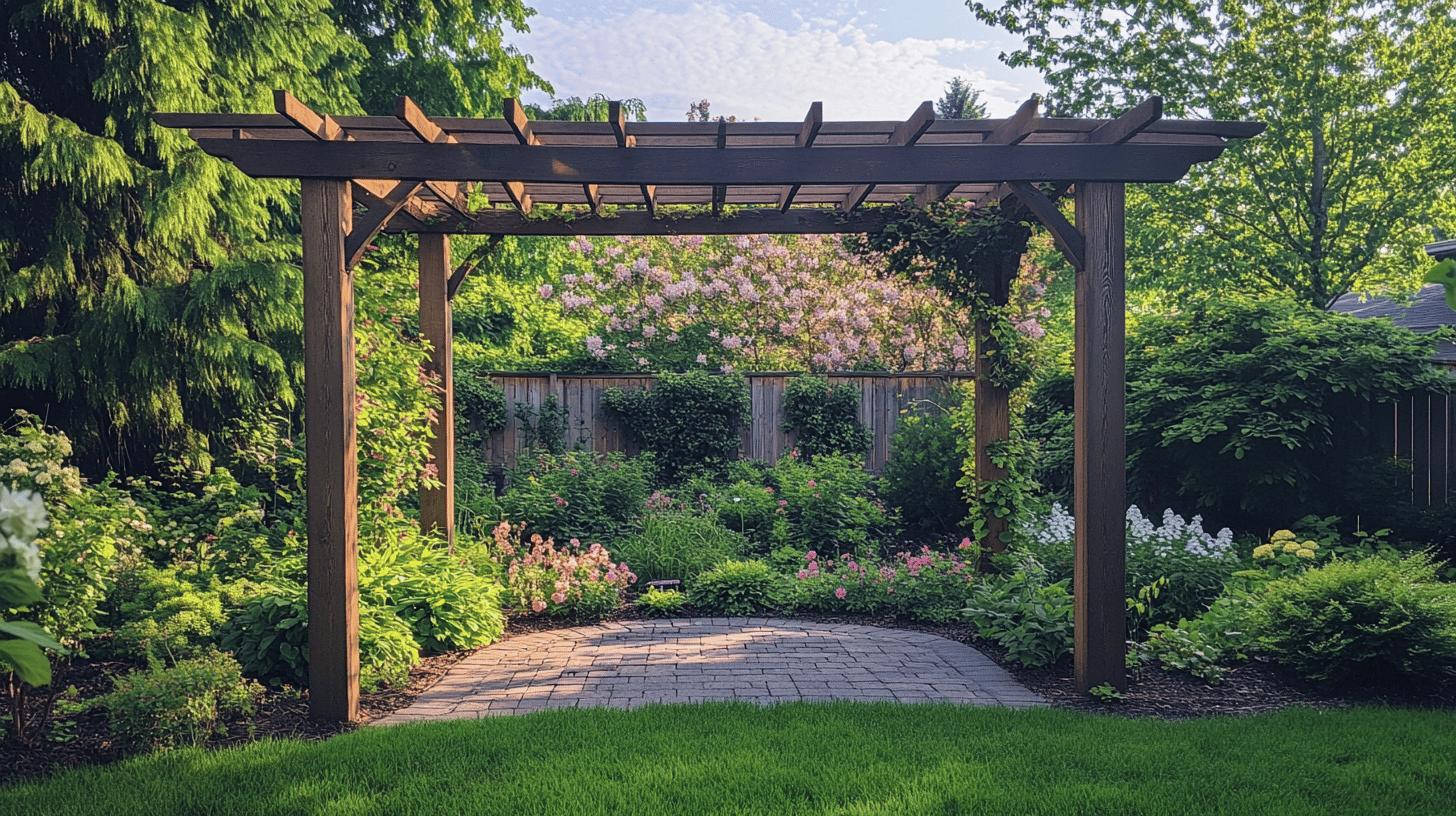
A well-built arbor asks for maybe an hour a year, but it’s a scheduled hour. In early spring I walk the structure and check for winter damage — loose screws, soft wood at the soil line, rusted hardware — and train the new season’s growth onto the frame with twine while the stems are still bendy. Late spring gets a light cleanup prune, never a hard cutback while a repeat-bloomer is setting flowers. Through high summer the job is mostly watching for growth so dense it presses leaves flat against wood for weeks, which traps moisture and quietly starts rot; thin it when you see it.
Fall is the real pruning window: climbing roses back by a third to push new wood, wisteria’s whippy runners back to short spurs near the frame, and clematis according to its group (1, 2, or 3 — the tag tells you, and the groups genuinely prune differently). Every second or third winter, reseal the wood — annually for pressure-treated pine in wet climates — and hit metal joints with a rust-inhibiting spray.
The failure I see most is rot at the soil line, and the fix is built in at install time: set posts on 4 inches of gravel inside the concrete footing so water drains away from the end grain. If a post has already gone soft, a steel post-saver bracket beats replacing the whole structure. Rust streaks on wood mean somebody used plain screws; swap them for stainless or galvanized before you restain. And an overgrown plant slowly racking the frame — almost always wisteria — is solved with aggressive fall pruning plus a cross-brace, not with hope.
Using Arbors to Define Spaces and Add Privacy
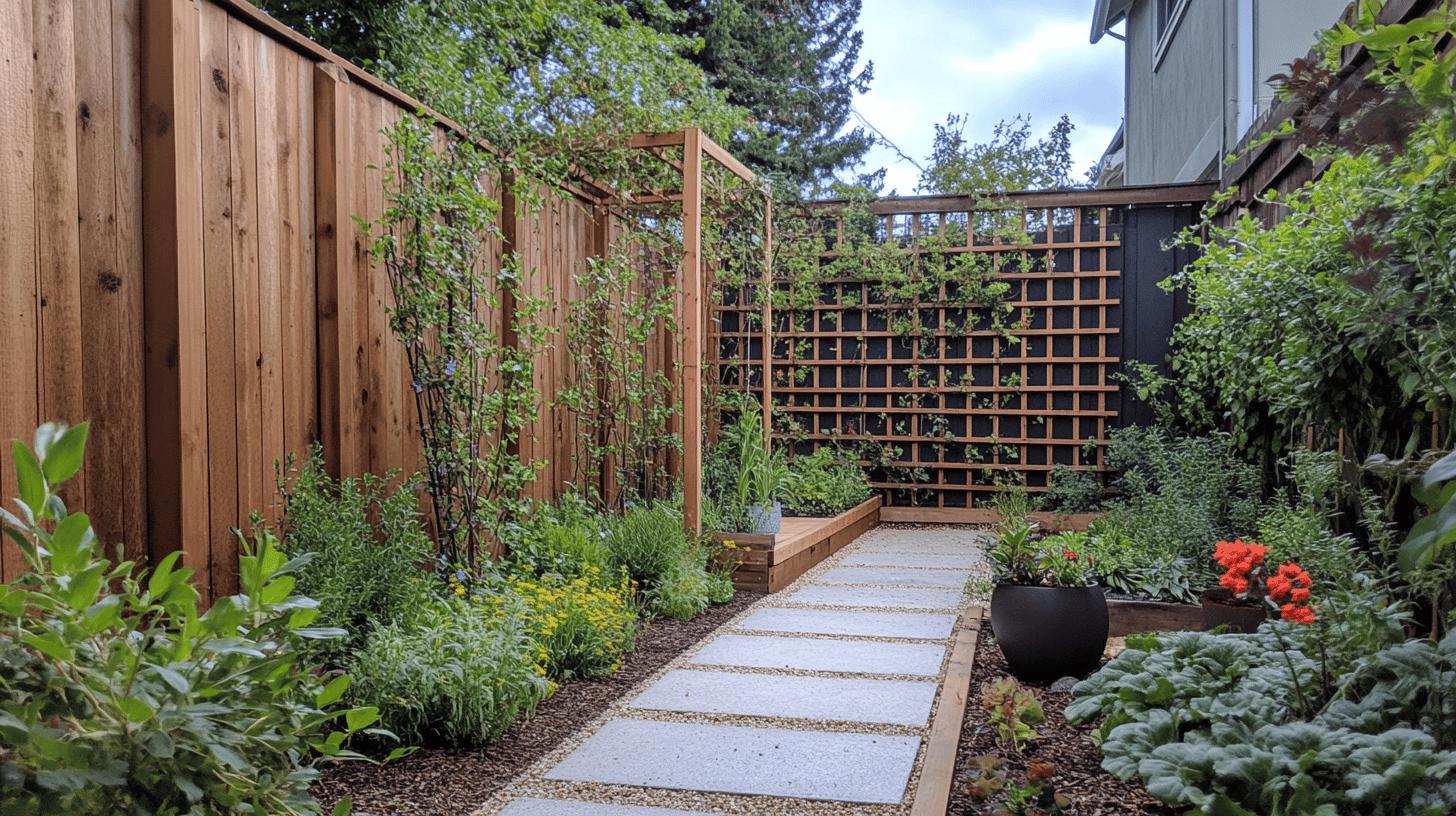
Once you’ve got one arbor up, you start seeing the other jobs these structures do. An arbor at the entrance to a vegetable garden or side yard creates that “you’re entering somewhere different” feeling that turns one backyard into several rooms. A trellis between the patio and the lawn separates the seating zone from the play zone without blocking the sightline to the kids. At the far end of a path, an arbor gives the eye a destination, which reliably makes a small yard read bigger than it is.
Privacy is where wall trellises earn their keep. A row of panels with climbers gives you screening without the visual weight of a solid 6-foot fence, and three lattice panels in an L around a hot tub make an instant private corner. For this kind of job you want rigid framed panels, not floppy roll lattice — a set like the Amagabeli 47-by-16-inch rustproof iron trellis two-pack ($) stakes straight into a bed or mounts flat to a fence, and the powder coating means it’s a plant-and-forget purchase. In a tight yard, this is the highest-leverage move there is: a trellis uses vertical space, which small yards have plenty of, instead of floor space, which they don’t. A 3-by-7-foot arbor occupies about 21 square feet of ground and carries the presence of something three times its size.
If the vertical idea grabs you, the next step up is a fully planted wall — our guide on how to design a living wall for outdoor spaces covers that build.
Recommended Gear for Your Arbor Project
Recommended gear for this project
As an Amazon Associate, Backyard Superstar earns from qualifying purchases at no extra cost to you.
- Top pick — Best Choice Products 92″ Steel Garden Arch ($$). True walk-through height, wire lattice climbers grab right away, one-wrench assembly.
- Budget pick — Amagabeli 47″×16″ Iron Trellis (2-pack) ($). Rigid rustproof panels for walls, fences, and privacy rows.
- Premium pick — Vita Florence 49″×94″ Vinyl Arbor ($$$). Zero-maintenance material with real presence at an entrance.
- Wood kit — Giantex 85″ Wooden Garden Arch ($$). Classic arched profile, afternoon assembly; seal it before winter.
- Wisteria-grade — Heavy-Duty 55″×87″ Metal Arch, Enlarged Base ($$). Wider footing plates built for heavy vine load.
- Build hardware — Stainless / UV-rated heavy-duty zip ties ($). The fastener of choice for cattle-panel builds.
Putting Your Garden Arbor Plan Together
Start with one structure in one specific spot, chosen for a specific job — frame the entrance, support the rose, screen the hot tub. Match the style to the yard you have, pick the material that fits your maintenance tolerance, and set the posts like you mean it. Don’t try to add five structures in one season; I’ve watched that plan produce five half-finished projects more than once.
The payoff comes twice. The day it goes up, the yard immediately looks more intentional, because vertical structure changes how flat space reads. Then over the next two or three growing seasons, the climber fills in and the modest arch you installed becomes the thing every guest walks over to. A well-chosen climbing rose on a basic $$ arbor ends up looking like the most expensive feature in the yard — and only you’ll know it wasn’t.
Common Questions About Garden Arbors and Trellises
What is the difference between a trellis and an arbor?
A trellis is a flat framework that climbing plants grow against, typically mounted on a wall or fence or staked in a bed. An arbor is a freestanding arched or squared structure you can walk through, usually marking an entrance or pathway. Both support climbers, but only an arbor works as a gateway.
Does an arbor need to be anchored?
Yes. Set the posts at least 2 feet deep in concrete to prevent uplift. Once a climbing plant fills in, the structure acts like a sail, and an unanchored arbor tips in the first major storm. A 4-inch gravel base under the footing drains moisture away from the wood.
Where should I put an arbor in my garden?
Place it at a meaningful transition — the entrance to a garden area, the start of a path, the end of a sightline, or the boundary between two zones. An arbor in the middle of a lawn with nothing on either side reads as ornament instead of architecture.
How do you secure a garden trellis in the ground?
Drive stakes or T-posts at least 18 inches deep and attach the trellis with brackets or U-bolts. For permanent installs supporting heavy climbers, set posts in concrete footings 2 feet deep. Wall-mounted trellises need masonry anchors or lag bolts into studs.
What materials are best for a durable garden arbor?
Cedar and redwood last 10–15 years without sealing. Pressure-treated pine lasts nearly as long with annual sealing. Powder-coated steel and aluminum run 15–20+ years with almost no upkeep. Vinyl is maintenance-free but looks synthetic up close and can turn brittle in hard-freeze climates.
Are DIY arbors a cost-effective option?
Yes. A walk-through arbor built from a cattle panel and pressure-treated 4×4 posts costs a fraction of a comparable pre-built unit and goes up in an afternoon with basic tools. Pallet wood and reclaimed lumber bring the cost down further for a more rustic look.
What climbing plants work best on garden arbors?
Repeat-blooming climbing roses (Eden, New Dawn), clematis, native trumpet honeysuckle, and American wisteria are the reliable choices. Put heavy climbers like wisteria only on substantial structures with 4×4 or 6×6 posts or a reinforced metal arch. Annual morning glories suit first-time builders who want same-season results.