How to Hang a Hammock, With or Without Trees
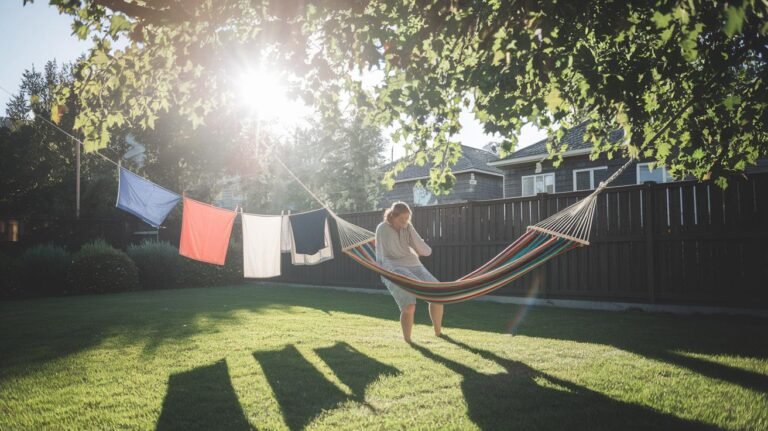
The fantasy is simple — drift off in a hammock in your own backyard. The reality trips people up on one question: what do you actually hang it from? Maybe you don’t have two perfectly spaced trees, or any trees at all, or your only flat-ish spot turns out to be a slope. I’ve hung hammocks every which way over the years, and the good news is that almost any yard can work. This guide covers all of it: between trees, on a stand, from posts you sink yourself, and across uneven ground.
As an Amazon Associate, Backyard Superstar earns from qualifying purchases at no extra cost to you.
The Two Numbers That Decide Everything
Before we get into trees versus stands, understand the two measurements that make or break every hammock hang, because they’re the same no matter what you’re anchoring to. The first is distance: your two anchor points want to sit roughly the length of your hammock plus a couple of feet apart. For a typical 10-to-13-foot hammock, that’s about 12 to 15 feet between points. Too close and you can’t get the right curve; too far and you’ll run out of strap.
The second is the hang angle, and this is the part most people get wrong. You’re not aiming for a tight, flat hammock — you want each strap leaving its anchor at about a 30-degree angle, which lets the hammock settle into a relaxed curve. Mount your anchor points around four to five feet up, let the middle sag so the lowest point sits about 18 inches off the ground, and you’ll have a seat that’s easy to get into and cradles you properly. A hammock pulled drum-tight feels like sleeping on a tightrope; a little sag is the whole secret.
Hanging Between Two Trees
If you’ve got the trees, this is the classic setup — but choose them carefully. You want two healthy, living hardwoods at least about a foot in diameter; anything skinnier can bend or snap under a swinging adult. Skip dead or hollow trees entirely, and look up for loose branches before you commit.
Please don’t wrap bare rope or screw hooks straight into the trunk — both strangle and scar the tree over time. Use proper wide hammock tree straps instead. They spread the load across a couple of inches of bark, adjust to dial in that 30-degree angle, and take about two minutes to set up and move. If your trees are a little farther apart than ideal, longer straps close the gap without any drama.
No Trees? Here’s What Actually Works
This is where most people land, and there are more options than you’d think. The easiest by far is a hammock stand — a self-contained frame that needs no trees, no digging, and no permanent fixtures, so you can move the whole thing into the shade or tuck it away for winter. A sturdy steel model like the Best Choice Products steel hammock stand holds a standard double cotton hammock and assembles in an afternoon. If you’re weighing which stand suits your space, I walk through it in detail in how to choose a hammock stand, and if you’d rather build your own, here are my pallet-wood hammock frame plans.
Beyond a stand, look at what’s already in your yard. A single tree paired with a sturdy post, a fence corner, or a wall anchor can stand in for the second tree. Pergola posts and solid deck framing often make excellent anchor points too — just be honest about whether the structure can take the dynamic, swinging load of a person, which is very different from a static weight.
Sinking Your Own Posts
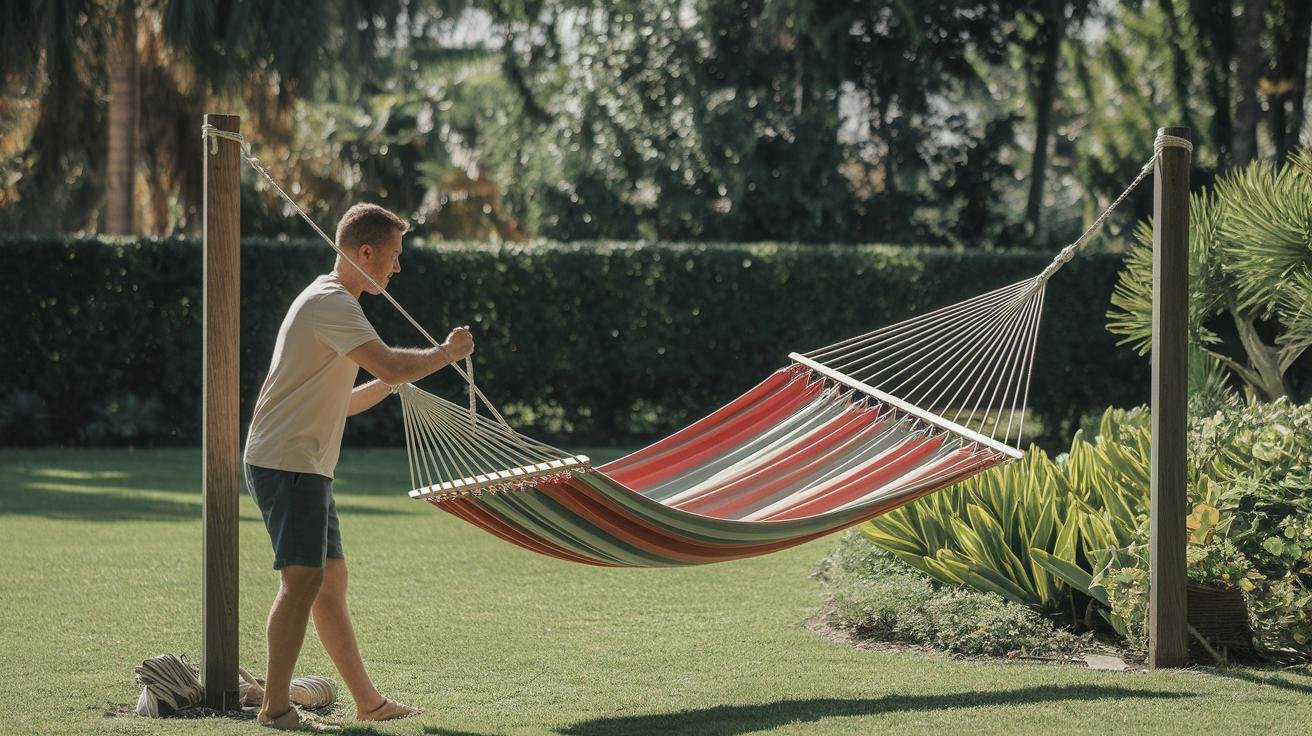
When there’s truly nothing to hang from, set your own posts — it’s more work, but it’s permanent and rock-solid. Use pressure-treated 4x4s at a minimum, though I prefer 6x6s for the reassuring lack of flex. Each post needs a concrete footing at least three feet deep, and crucially below your local frost line, or winter heave will loosen it within a season or two. Set the posts in concrete, let it cure fully for a couple of days before you trust it, then attach your hardware near the top.
For the connection itself, structural lag screws driven into the post — or heavy galvanized angle brackets for a hanging chain — are what you want. Ordinary screw-in hooks aren’t rated for a swinging person, so don’t be tempted.
Hanging on Uneven or Sloped Ground
A slope looks like a dealbreaker but rarely is. The trick is to stop trying to make the anchor points level with each other and instead level the hammock. Mount the anchor on the downhill side higher up its tree or post, and the uphill anchor lower, so the hammock bed itself ends up roughly horizontal once you’re in it. Adjustable straps make this painless — you just take up more length on one side.
On a real grade, sunk posts give you the most control because you decide exactly how high each one sits. Account for the slope when you cut them, and always test the hang sitting low and slow before you fully commit your weight, so a surprise tilt deposits you six inches onto soft grass rather than dropping you.
Getting the Hang Just Right
Once it’s up, resist the urge to crank it tight. Aim for that gentle banana curve, then lie across it on a slight diagonal rather than straight down the middle — the diagonal flattens out the fabric and is the single biggest comfort upgrade most people never discover. If you’re sitting too low and scraping the ground, shorten the straps or raise the anchors a few inches; if it feels too high and tippy, do the opposite. A minute of fiddling is the difference between a hammock you tolerate and one you fall asleep in.
A Few Finishing Touches
Two quick things worth checking. Confirm your setup’s weight capacity — the hammock, the hardware, and the anchors all have limits, and the weakest one wins. And once it’s hung, a little greenery around it makes the spot feel like a retreat; I’ve gathered my favorites in the best plants for a hammock area. When the season winds down, a quick read of how to clean and maintain your hammock keeps it ready for next summer.
Frequently Asked Questions
How far apart should the anchor points be?
Roughly your hammock’s length plus a foot or two — about 12 to 15 feet for a standard hammock. Adjustable straps cover small mismatches.
Can I hang a hammock without any trees?
Absolutely — a hammock stand is the simplest no-tree option, and sunk posts or existing structures like pergolas work too.
Is it safe to screw hooks into a tree?
No — use wide tree straps. Hooks and bare rope damage the bark and aren’t reliably rated for a swinging load.
How do I hang a hammock on a slope?
Set the downhill anchor higher and the uphill one lower so the hammock bed sits level, and use adjustable straps to fine-tune.
Get the distance and the 30-degree angle right, pick the anchoring method that fits your yard, and you’ll be swinging in no time — trees entirely optional.