Best Wicker Patio Lounge Chairs: Buyer’s Guide
A wicker patio lounge chair is one of those purchases that looks simple and then isn’t. Two chairs can sit side by side at the same price, both called “all-weather,” and one of them will still be crisp and comfortable in five summers while the other sags, fades, and starts shedding little plastic splinters by the second August. I’ve bought the wrong one before, so I know the difference now costs about ten minutes of reading the spec sheet instead of the chair itself.
This guide is the version of that reading I wish I’d had. I’ll walk you through what actually makes a wicker lounge chair last outside, five real chairs worth your money across three budgets, how the cushions and frames should feel, and the short maintenance routine that keeps any of them going. No hype, no mystery — just what to look for and what I’d buy.
As an Amazon Associate, Backyard Superstar earns from qualifying purchases at no extra cost to you.
What Actually Makes a Wicker Chair Last Outside
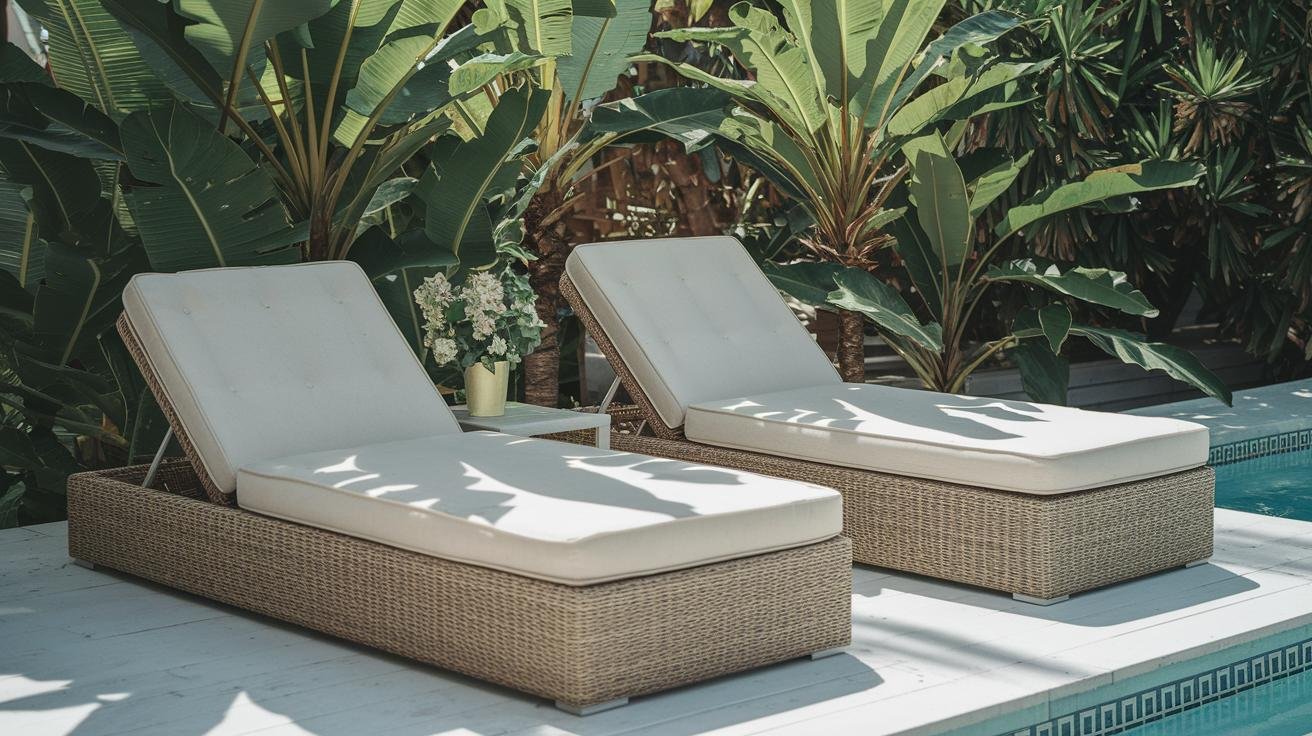
Start with the material, because it decides everything else. “Wicker” is a weave, not a substance — you can weave natural rattan or you can weave synthetic resin, and outdoors those two age in completely opposite directions. Natural wicker drinks up moisture, swells, and cracks the first time it goes through a wet spring and a dry summer. Resin wicker, which is really high-density polyethylene strands dyed and woven to look like rattan, shrugs all of that off. It doesn’t absorb water, it stays cool enough to sit on in direct sun, and a good grade won’t fray or rot. If a chair is going to live on an uncovered patio, you want resin — full stop.
Not all resin is equal, though, and the tell is UV rating. Cheap resin gets brittle and chalky after a couple of seasons in strong sun; the better stuff is rated for something like 3,000 hours of UV exposure, which translates to years of holding its color instead of fading to a sad gray. It’s worth finding that number on the product page before you buy, because it’s the single spec that best predicts whether a chair still looks good in year three.
Then look underneath at the frame, because the weave is only as trustworthy as what it’s wrapped around. You want powder-coated aluminum or powder-coated steel. Aluminum is the smarter pick for most people — it’s light enough to drag across the deck to chase the shade, and it flat-out will not rust, which matters if you get coastal salt air or just a lot of rain. Steel is heavier and sturdier but relies entirely on that powder coating staying intact; once it chips and water finds bare metal, rust creeps out from the inside. Whichever it is, check the stated weight capacity. Most quality lounge chairs handle 300 pounds or more, and a chair that only claims 250 is usually cutting corners on the frame you can’t see.
Five Wicker Lounge Chairs Worth Buying
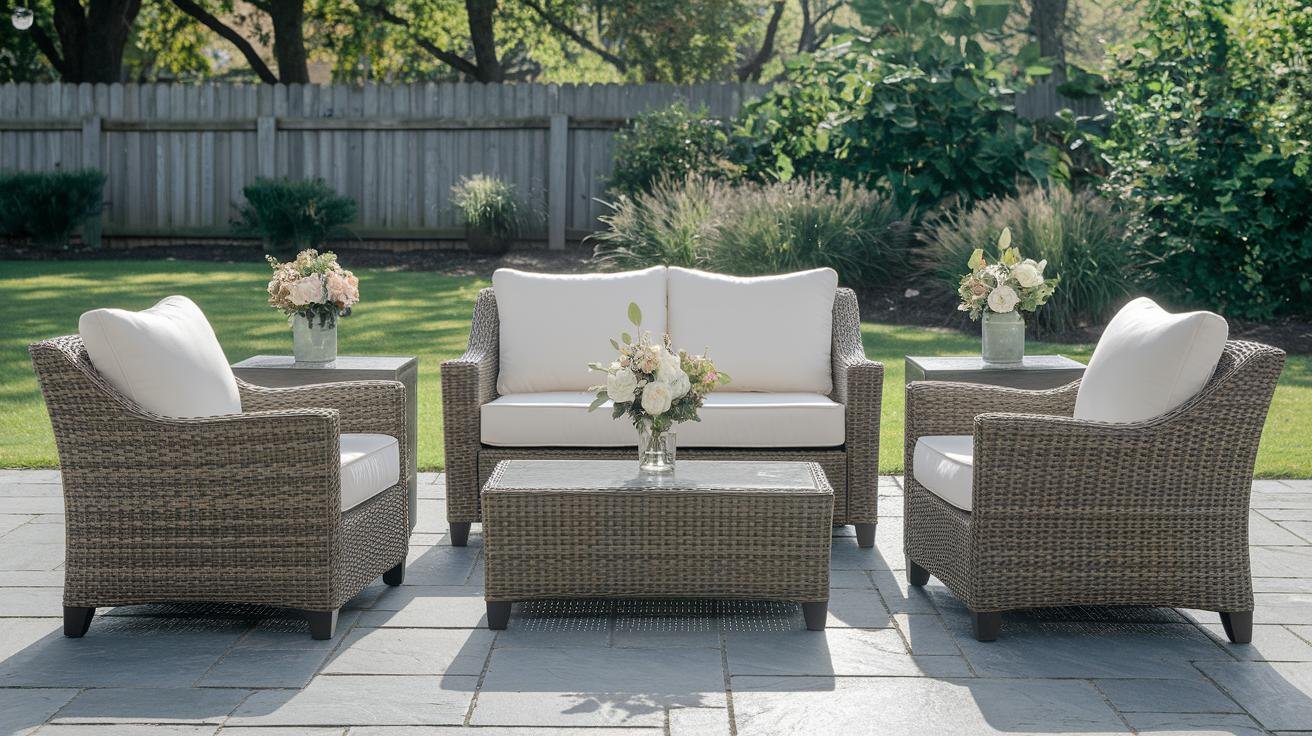
Here are five chairs I’d actually put money on, spread across budgets, all in genuine resin wicker over rust-resistant frames. I’ve grouped them by what job they do rather than ranking them one to five, because the “best” one honestly depends on whether you want to nap flat, prop up with a book, or just not spend much. Prices shift with sales and finish, so I’ve marked each with a rough tier — $ is entry-level, $$ is mid-range, $$$ is premium — instead of a number that’ll be wrong by next week.
The budget entry point is a plain resin wicker chaise lounge ($). You give up the push-back recline and the plush cushion, but you get a hand-woven all-weather seat on a powder-coated frame that you can leave out all season, and for a poolside or a spare corner that’s often all you need. Look for one that specifies HDPE resin and a stated weight rating rather than just the word “wicker,” and you’ll dodge the truly flimsy ones.
Step up to the mid tier and reclining becomes the whole point. The ART TO REAL adjustable wicker recliner ($$) is the one I keep pointing friends toward: it rides on an all-weather aluminum frame, carries a thick multi-inch cushion, and the back adjusts by leaning — no levers to fuss with — so you can go from upright to nearly flat by shifting your weight. It’s the sweet spot where the comfort jumps but the price hasn’t yet. If you’d rather have a locking, lie-flat design with a little built-in surface for a drink, the Grand Patio push-back wicker recliner ($$) uses double-strand, UV-rated resin over a powder-coated frame and includes a flip-out side tray, which sounds like a gimmick until the first time you set a coffee down without leaning off the chair.
At the top, you’re paying for thickness and a matching ottoman. The Babylon outdoor wicker recliner with ottoman ($$$) hand-weaves PE wicker over an aluminum frame, reclines across a wide range by pushing on the armrests, and ships with deep cushions plus the footrest — so it lounges more like an outdoor easy chair than a poolside slat. It’s the splurge, but if this is the chair you’ll actually live in on summer evenings, the extra cushion depth is where that money goes.
| Pick | Best for | Recline | Frame | Tier |
|---|---|---|---|---|
| Resin wicker chaise lounge | Budget / poolside | Fixed or manual back | Powder-coated | $ |
| ART TO REAL adjustable recliner | Everyday lounging | Lean-to-adjust | Aluminum | $$ |
| Grand Patio push-back recliner | Lie-flat + drink tray | Locking push-back | Powder-coated | $$ |
| Babylon recliner with ottoman | Deep comfort / evenings | Wide push-back | Aluminum | $$$ |
If you only take one thing from this section: match the chair to how you’ll sit, not to the prettiest photo. A flat chaise is wasted on someone who wants to read upright, and a deep recliner is overkill next to a pool you jump in and out of. Pick the posture first, then the budget.
Cushions and Comfort: What to Feel For
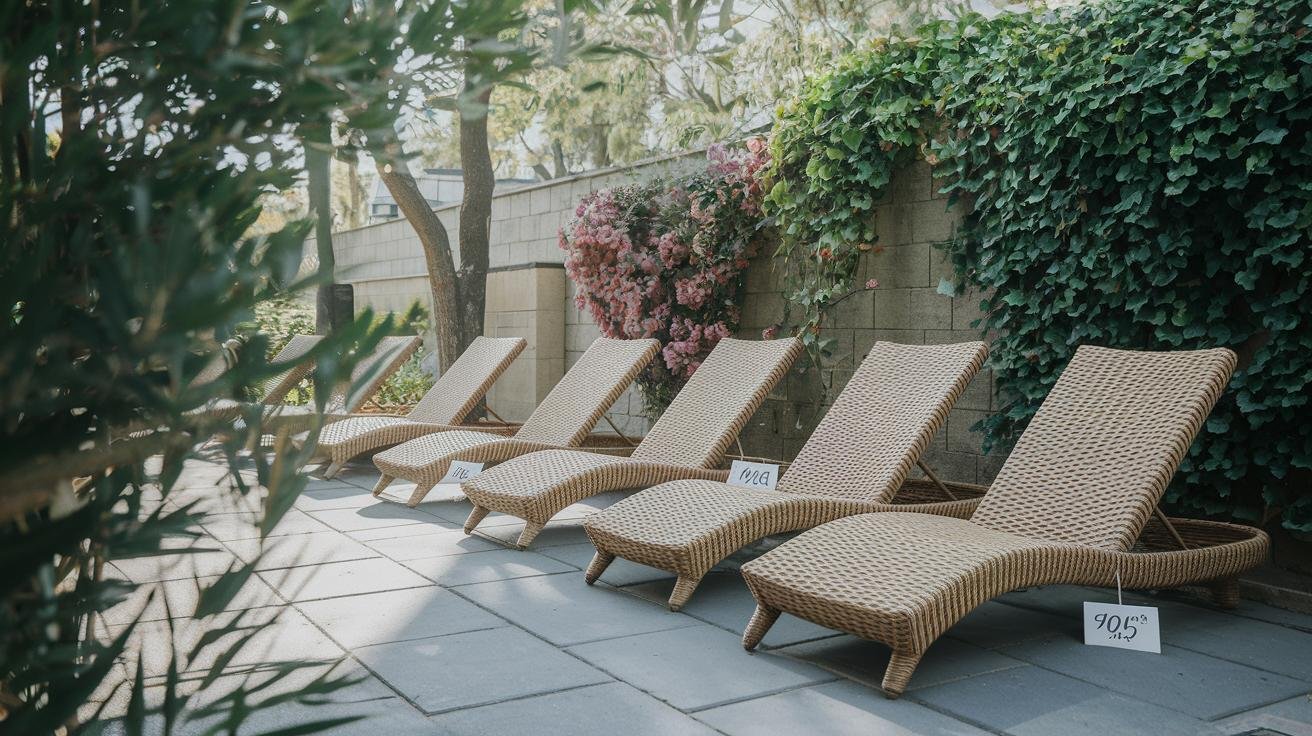
The frame decides how long a chair lasts; the cushion decides whether you sit in it. The best outdoor cushions use quick-dry foam wrapped in a UV- and mildew-resistant fabric, and the combination matters more than the thickness number on the listing. Quick-dry foam has an open structure that lets water drain straight through instead of soaking in, so a surprise shower or a sprinkler overspray beads on top and the cushion is usable again in an hour rather than staying a damp sponge all afternoon. That one feature is the difference between cushions you leave out and cushions you’re forever hauling inside.
Fabric is the other half. You want the cover treated to resist fading and mildew, because those are the two things that kill outdoor cushions — the sun bleaches the color and the damp grows spots in the seams. The premium fabrics here are solution-dyed acrylics and olefins, where the color runs all the way through the fiber instead of sitting on the surface, so they hold their tone for years; if you want the full rundown on which fabric survives your climate, our guide to UV-resistant patio lounge chair fabrics breaks down acrylic versus olefin versus polyester in plain terms.
Beyond the materials, a couple of comfort features earn their keep. A built-in lumbar pillow or a contoured back makes a real difference on a chair you’ll be in for an hour, and multi-position or push-back recline lets one chair serve for both reading and napping. Removable, zip-off covers are the quiet MVP, though — when the iced tea goes over (and it will), being able to pull the cover and run it through the wash is what keeps the chair from looking tired by midsummer.
How Much to Spend, and What Each Tier Gets You
You don’t need to overspend to get a chair that lasts, but you do need to know what each price band actually buys, because the jumps aren’t subtle. Here’s how the three tiers shake out in practice.
In the entry band you’re getting a straightforward seat: a simple cushion, a sturdy resin weave, and a frame rated for roughly 250 to 300 pounds. These are light enough to rearrange on a whim and tough enough to survive the season, and for a poolside chaise or a rarely-used guest chair they’re honestly plenty. What you give up is the plush recline and the thicker foam — you’re buying durability, not luxury.
The mid band is where most people should land. Step up here and the cushions get noticeably thicker and quick-drying, the recline usually becomes adjustable so you can dial in the angle, and the frames move to powder-coated aluminum that resists rust outright. This is the range where a chair stops being “fine” and starts being the seat you actually seek out, and the durability-per-dollar is at its best. If you’re buying one chair to keep for years, spend here.
The premium band is about refinement rather than survival. You’re paying for designer weaves in deeper finishes, plush multi-position backs, fade-resistant designer fabrics, and extras like a matching ottoman or an extended frame warranty. None of it makes the chair last dramatically longer than a good mid-tier pick — it makes it more comfortable and better-looking while it does. Worth it if this is the centerpiece of your patio; overkill if it’s a backup seat.
One practical note that applies across all three: check the return window before you commit. Most sellers give you 30 to 90 days, and a lounge chair is exactly the kind of thing you want to actually sit in for a week or two at home — angle, cushion firmness, and how it fits your space are hard to judge from photos. If it’s not right, that window is your friend.
Keeping Them Alive: Maintenance That Actually Matters
The good news is that resin wicker is close to maintenance-free; the bad news is “close to” isn’t “totally,” and the small stuff is what people skip. The core routine is genuinely easy. Every month or so, mix a squirt of mild dish soap into warm water, work it into the weave with a soft brush, rinse, and let it air-dry — that’s it for the wicker itself. Skip harsh detergents and pressure washers, which can wear down or blast apart the fibers over time. If you want the material-by-material version, our breakdown of how to clean patio lounge chairs by material covers resin, natural rattan, and metal separately.
Cushions want a lighter touch: unzip the covers and run them through a gentle wash cycle, then air-dry them in the shade so they don’t fade or shrink. While you’ve got the cushions off, run your fingers along the weave and look for tiny cracks or loose strands — catching a snag early and tucking or gluing it beats letting it unravel into a hole. For anything that’s earned a permanent spot on your patio, the maintenance rabbit hole goes a little deeper (sealing, mildew treatment, re-tightening a sagging weave), and our full guide to maintaining wicker patio lounge chairs walks through it.
The single highest-return habit, though, is covering the chairs when they’re not in use. A fitted waterproof patio furniture cover ($) keeps rain, pollen, and hard UV off the weave and cushions, and it does more to extend a chair’s life than any cleaning routine — sun and standing water are what age outdoor furniture, and a cover blocks both. For winter, either drop the covers on tight or move the chairs into a shed or garage; a cool, dry spot beats an exposed patio through freeze-thaw season every time. Do that much and even a mid-tier chair will look new for years.
Styling the Space Around the Chairs
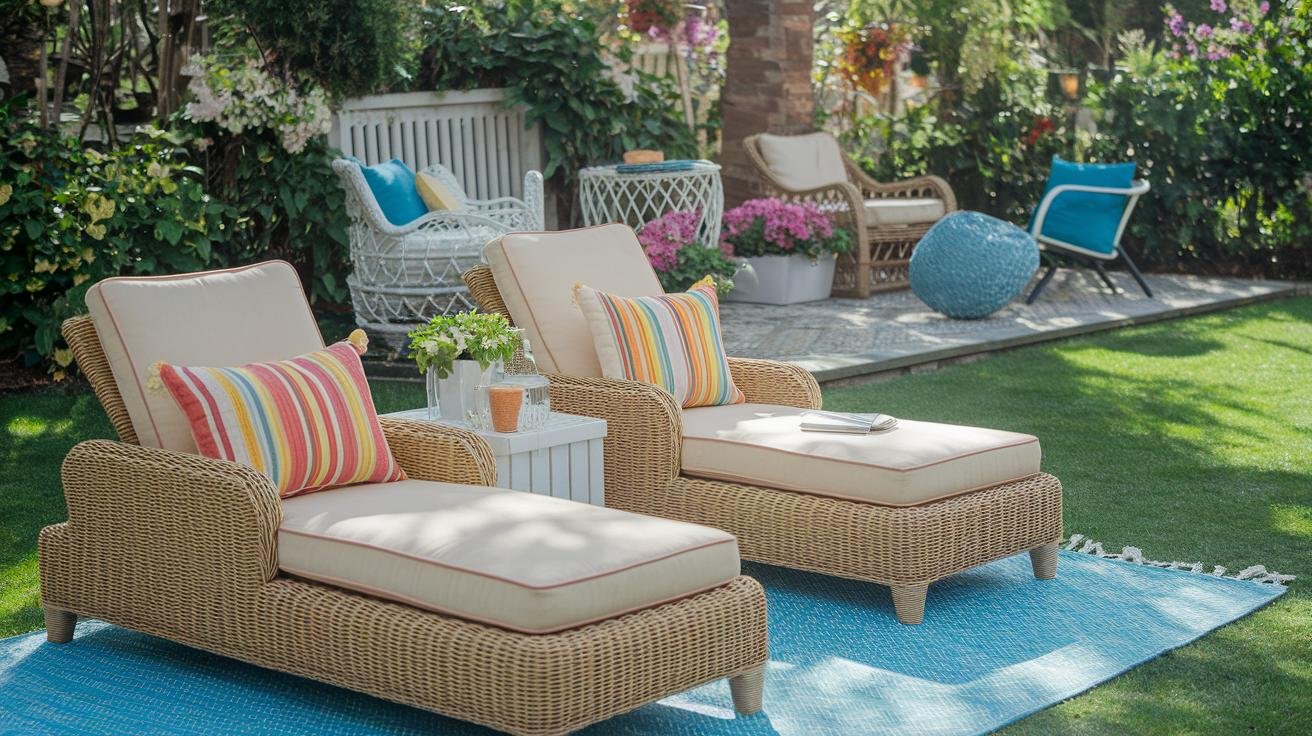
A wicker lounge chair looks better as part of a little scene than marooned alone on a slab, and the props to pull that off are cheap. Start with a couple of accent throw pillows in a color that isn’t beige — bright blues and greens for a coastal feel, terracotta and olive for something earthier — because two pillows do more to make a chair look inviting than almost anything else you can add. Mixing textures helps too; a chunky knit or a fringed throw next to the smooth weave gives the eye something to land on.
Then anchor the arrangement. A small side table gives you somewhere to set a drink, a book, or a potted plant, and an outdoor rug underneath pulls the chairs, table, and pillows into one defined lounge zone instead of a scatter of furniture. Jute or a low-pile all-weather rug tucks neatly under the legs and instantly makes the corner read as a “room.” If you want the whole space to feel like a destination rather than just some chairs, our guide to creating a relaxing backyard oasis gets into lighting, shade, and layout.
My one styling rule is restraint: pick about three colors and three materials — say, wicker, metal, and a natural fiber — and stop there. A rug, two pillows, and a side table per chair is usually the whole recipe. Outdoor spaces get cluttered fast, and the point of a lounge chair is to make you want to sit down and do nothing, which is hard to do surrounded by stuff.
Recommended wicker lounge chairs & gear
As an Amazon Associate, Backyard Superstar earns from qualifying purchases at no extra cost to you.
- Budget pick — Resin wicker chaise lounge ($). All-weather HDPE weave on a powder-coated frame — the no-frills poolside seat.
- Everyday best — ART TO REAL adjustable wicker recliner ($$). Lean-to-adjust back, thick cushion, rustproof aluminum frame.
- Lie-flat pick — Grand Patio push-back recliner ($$). Locking flat recline, UV-rated resin, built-in flip tray.
- Premium — Babylon wicker recliner with ottoman ($$$). Deep cushions, wide push-back recline, matching footrest.
- Protect it — Waterproof patio chair cover ($). Blocks rain and UV — the cheapest way to add years to any chair.
Frequently Asked Questions
What makes synthetic resin wicker better than natural wicker for outdoor chairs?
Synthetic resin wicker is woven from HDPE plastic strands that don’t absorb water, so it won’t swell, crack, or rot the way natural rattan does outdoors. A UV-rated resin also holds its color for years instead of fading, which is why it’s the material to choose for any chair that lives on an uncovered patio.
Do powder-coated aluminum frames really matter?
Yes. Powder-coated aluminum resists rust outright and stays light enough to move around the deck, and most quality frames are rated to hold 300 pounds or more. Powder-coated steel is sturdier but can rust from the inside if the coating chips, so aluminum is the safer long-term pick for wet or coastal climates.
What cushion features should I look for?
Look for quick-dry foam wrapped in UV- and mildew-resistant fabric, ideally a solution-dyed acrylic or olefin so the color runs through the fiber. Zip-off, machine-washable covers and a built-in lumbar pillow or contoured back are the extras that make a chair comfortable for the long haul.
How much should I spend on a wicker lounge chair?
Entry-level resin wicker chairs are the budget tier, mid-range recliners with thicker cushions and aluminum frames are the sweet spot for durability and comfort, and premium models add designer weaves, plusher cushions, and extras like a matching ottoman. Most people get the best value in the mid tier.
How do I clean and maintain wicker patio lounge chairs?
Wash the weave every month or so with mild soap, warm water, and a soft brush, then rinse and air-dry — skip harsh detergents and pressure washers. Machine-wash the cushion covers on a gentle cycle, air-dry in the shade, and cover or store the chairs when they’re not in use to block sun and rain.
Can I leave wicker lounge chairs outside year-round?
Resin wicker handles being outdoors far better than natural wicker, but it still lasts longest if you cover the chairs when they’re not in use and move them into a shed or garage for winter. A fitted waterproof cover and a dry off-season spot prevent the mildew and freeze-thaw damage that age outdoor furniture fastest.
How do I style wicker lounge chairs on my patio?
Add a couple of accent throw pillows, a small side table for drinks, and an outdoor rug underneath to define the lounge zone. Stick to about three colors and three materials for a clean look, and mix a soft texture like a knit throw against the smooth weave to keep it inviting.
The Bottom Line
A good wicker lounge chair isn’t complicated to buy once you know the three things that matter: UV-rated resin over a powder-coated or aluminum frame, a quick-dry cushion in fade-resistant fabric, and a recline that matches how you actually sit. Get those right and almost any budget works — a plain resin chaise for poolside, a mid-tier adjustable recliner for the seat you’ll use every day, or a cushioned recliner with an ottoman if this is the chair you’ll sink into all summer. Add a cover, run a soft brush over the weave now and then, and the chair you buy this year will still be the best seat in the yard several summers from now.