How to Choose Outdoor Curtains for Your Patio
The first set of outdoor curtains I ever hung were cheap polyester panels in a deep terracotta, and by August they’d faded to a tired salmon pink. I loved them anyway — because even faded, they turned a bare concrete slab into a room. That’s the real magic of outdoor curtains for a patio: shade and privacy, yes, but mostly the feeling that this space was made on purpose. Choosing well comes down to five decisions — fabric, size, hardware, care, and wind — and getting the fabric right matters most, because it decides how the other four go.
As an Amazon Associate, Backyard Superstar earns from qualifying purchases at no extra cost to you.
What Outdoor Curtains Change About a Patio
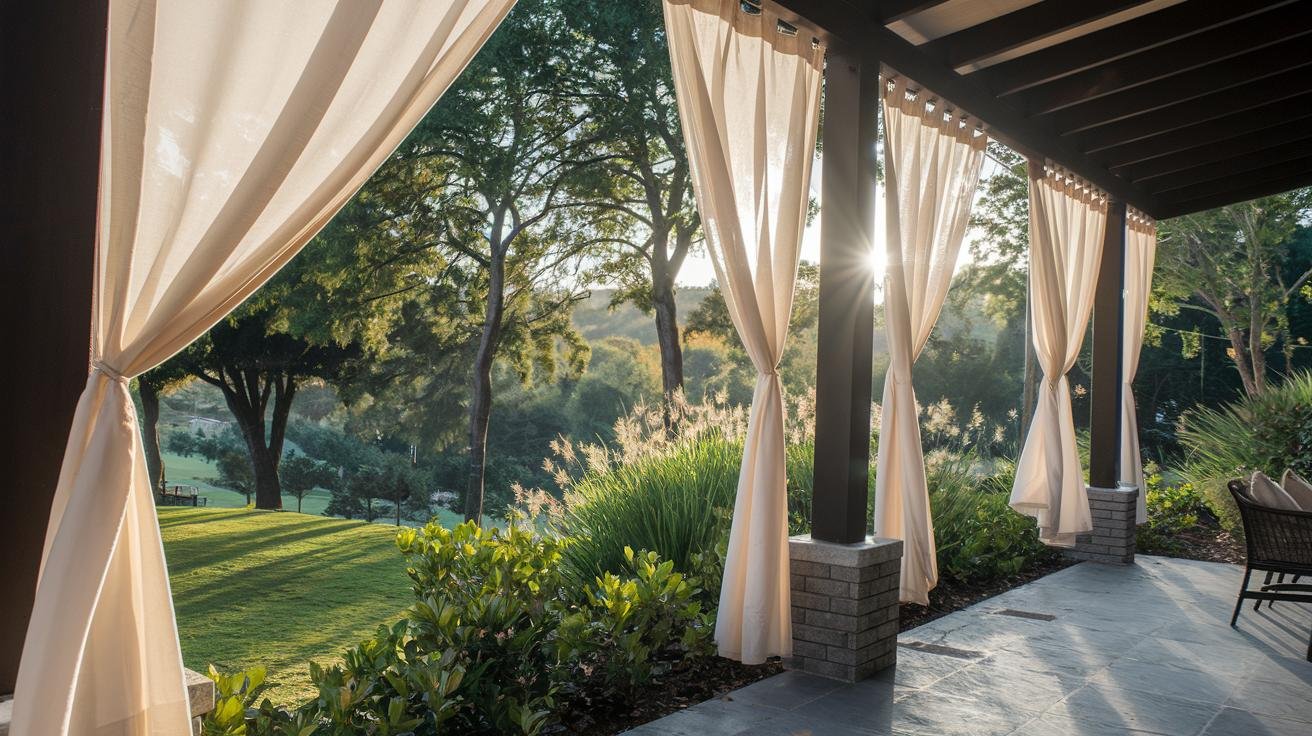
A good panel does three jobs at once. It softens harsh afternoon light into something you can actually sit in — my west-facing patio was unusable from four o’clock on until curtains went up. It blocks sightlines from the neighbors without walling anything off, since fabric still moves and breathes. And it adds the one thing hardscape can’t: softness. Stone, pavers, and metal furniture all read as hard edges until something drapes and catches the breeze.
Curtains earn their keep fastest in two situations. West-facing patios with brutal late-day sun are the obvious one. The other is any covered structure — a pergola, a porch roof, a pavilion — where you already have mounting points overhead and exposed sides begging to be softened. If you’re still planning the structure itself, our guide to budget-friendly pergola designs covers builds that pair beautifully with curtain panels.
The honest caveat: curtains are the wrong tool for a constantly windy site. They’ll flap, snap, and eventually tear no matter how you weight them, and a rigid screen will serve you better. They’re also not true year-round weather protection — more on both alternatives near the end.
Choosing a Fabric That Can Live Outside
Indoor curtains hung outside die quickly — sun bleaches them and the first damp week grows mildew in the folds. Outdoor fabrics are a different animal, and the label term worth learning is solution-dyed: the color is locked into the fiber before the fabric is woven, instead of printed on after. That’s why solution-dyed acrylic keeps its color for years while a printed polyester fades in a season or two — the same chemistry covered in our guide to UV-resistant patio lounge chair fabrics.
| Fabric | Sun resistance | Rain behavior | Care | Price tier |
|---|---|---|---|---|
| Outdoor-rated polyester | Moderate — noticeable fade in a few seasons | Sheds light rain | Machine wash, gentle | $ |
| Sheer voile (outdoor) | Filters glare, doesn’t block it | Dries fast | Machine wash, gentle | $ |
| Waterproof triple-weave polyester | Good — blocks most direct sun | Repels rain, dries quickly | Machine wash, gentle | $$ |
| Canvas (heavy cotton) | Moderate without treatment | Absorbs water, can mildew | Spot clean only | $$ |
| Solution-dyed acrylic (Sunbrella and similar) | Excellent — holds color for years | Sheds rain, resists mildew | Hand wash or spot clean | $$$ |
For most patios, my pick is a waterproof triple-weave polyester panel like the RYB HOME waterproof outdoor curtains ($$, sold as a two-panel set). The manufacturer rates the triple weave to block most direct sunlight and UV, it shrugs off a rain shower, and it goes in the washing machine on gentle — which, three summers in, is the feature I appreciate most. The catch is a slightly stiffer hand than acrylic; it hangs in broader folds rather than soft ripples.
If the budget allows one splurge, make it solution-dyed acrylic. A Sunbrella Canvas outdoor curtain with nickel grommets ($$$) is the panel you buy once and stop thinking about — the color a client of mine chose for her pergola five years ago still reads true today. And at the airy end, an outdoor sheer like the BONZER white outdoor sheer curtains ($, two panels) won’t give you blackout shade, but the way morning light glows through white voile is half the reason people fall in love with curtained patios in the first place. I often layer a sheer behind a solid panel and let the mood decide which one gets drawn.
Getting the Size Right
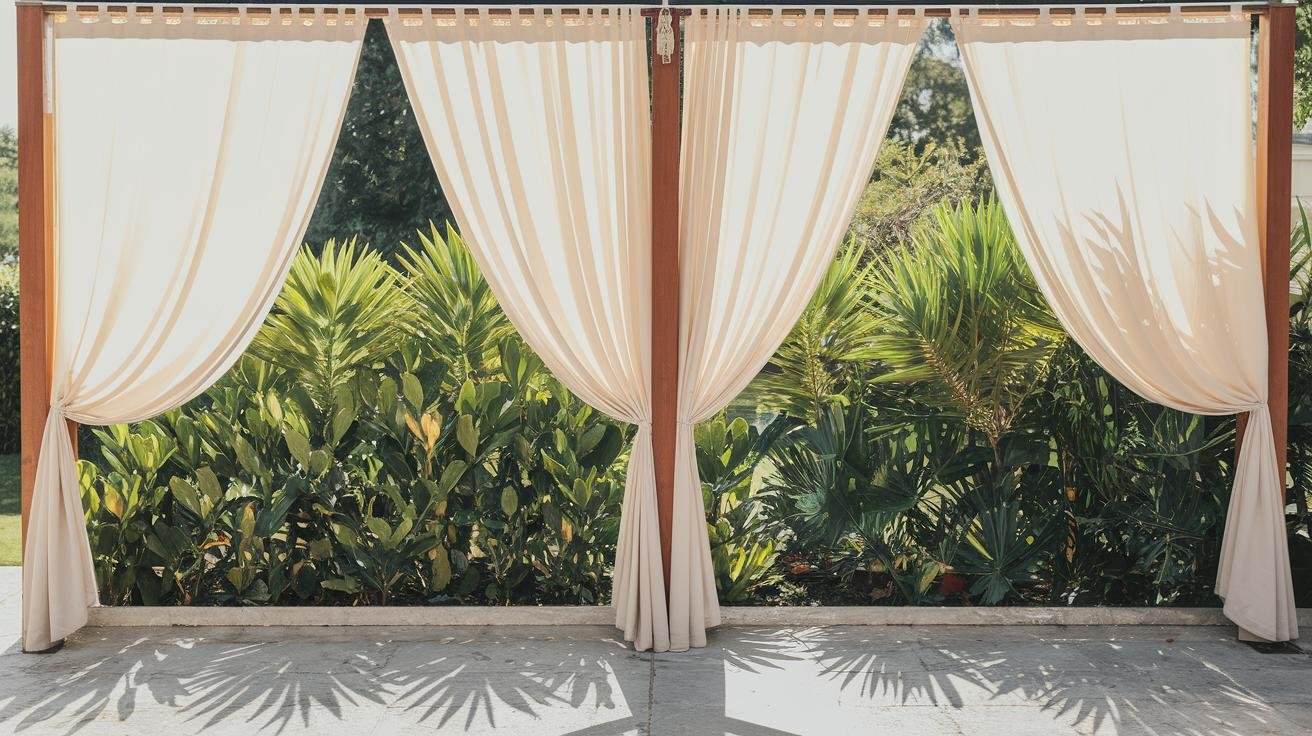
Skimpy curtains are the most common mistake I see, and the fix is one multiplication. Panels need fullness — extra fabric width beyond the opening — or they hang flat and stingy, like a bedsheet pinned over a doorway. Here’s the sequence I use:
- Measure your span, post-to-post or bracket-to-bracket.
- Multiply by 1.5 to 2. A 10-foot span wants 15 to 20 feet of total fabric width.
- Divide by your panel count to see what each panel must measure. Standard outdoor panels run 50 to 54 inches wide, so that 10-foot span comfortably takes four of them.
- For length, measure from the rod to where you want the hem — 84, 96, and 108 inches are the standard drops.
Because outdoor panels billow, err generous on width. I’d rather see five relaxed panels than four straining ones. On length, a hem that kisses the patio floor looks intentional; one that puddles collects leaves and soaks up every rain shower.
Hanging Them: Rods, Cable, and No-Drill Options
Hardware outside has one extra enemy — rust — so ordinary indoor rods streak orange within a season. For a permanent setup on a pergola beam, wall, or porch frame, a purpose-built rod like the RYB HOME rustproof outdoor curtain rod ($$, adjustable up to 168 inches, rated for heavy panels) is the straightforward answer for long patio spans. For a shorter covered opening, the Kenney Weaver rust-resistant curtain rod ($) does the same job at standard-window widths.
Mounting is a one-afternoon project. Mark your bracket points a few inches above the opening, check them with a level, and drill pilot holes — a masonry bit for brick or concrete, a standard bit for wood posts. Use stainless or galvanized screws on wood pergolas, because plain hardware weeps rust streaks down the grain after the first wet month. Then thread the grommets on, hang the rod, and slide everything back and forth a few times before you call it done.
Two situations call for different hardware entirely. On spans past twelve feet or so, a single rod sags in the middle — a stainless cable kit strung taut between posts carries grommeted panels without the droop. And if you rent, or won’t drill into the structure, spring-tension rods wedge between two parallel surfaces and leave no holes behind.
Keeping Them Clean and Alive Longer
Outdoor curtains want a proper wash every three to six months during the season, and the method follows the fabric. Polyester and triple-weave panels go in the machine on cold and gentle, then back on the rod damp so they dry crease-free. Solution-dyed acrylic prefers a hand wash in cool soapy water. Canvas is spot-clean only — the washing machine shrinks and warps it — and anything with a waterproof coating just gets a wipe-down, since dryer heat breaks the coating down.
Mildew is the enemy in humid climates, and it starts in folds that stay damp. I give mine a light going-over with a fabric mildew inhibitor at the start of each season; diluted white vinegar — one part to four parts water, misted on and left to dry — works as the pantry version. The single best habit, though, costs nothing: take the panels down before storms and for the off-season, wash them, and store them loosely rolled indoors. That one routine roughly doubles how long any outdoor curtain lasts, in my experience.
Styling and Wind: The Two Things Everyone Underestimates
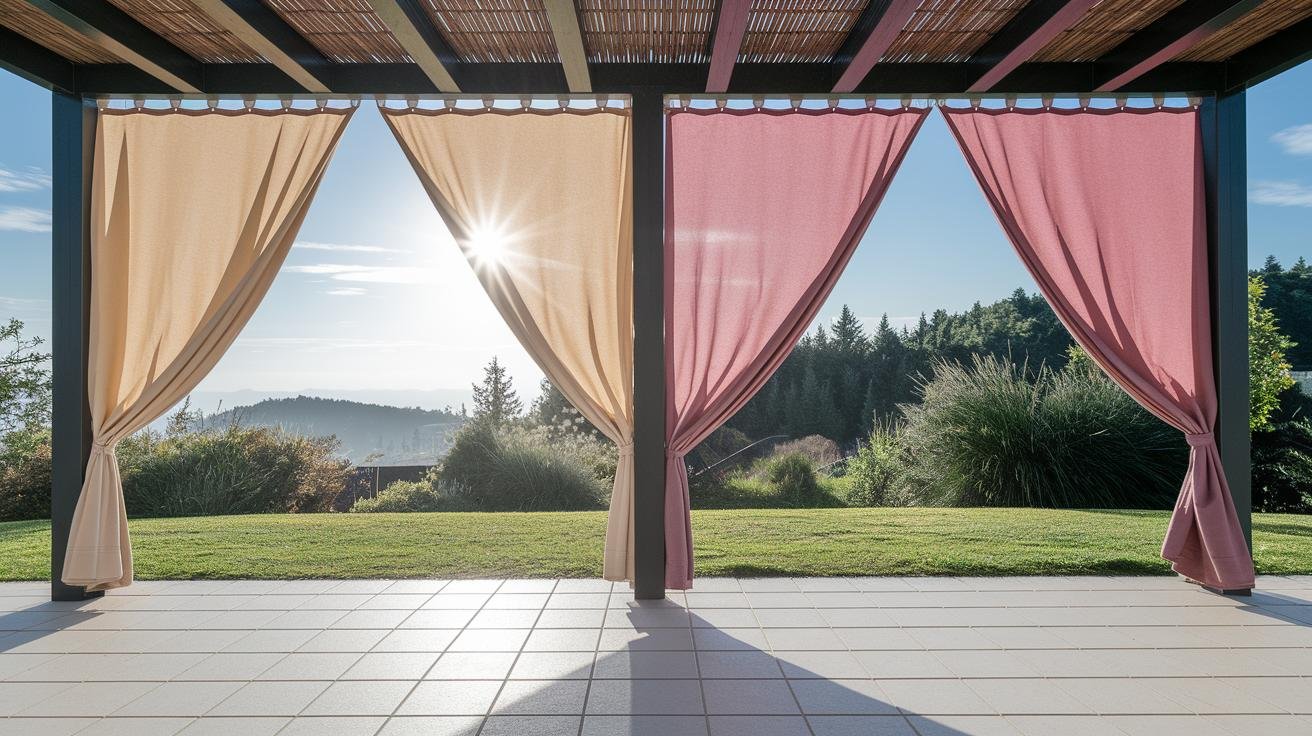
Styling first, because it’s the fun one. Start with a neutral base — cream, taupe, or charcoal solids on the main panels — and add at most one accent: a stripe, a texture, a single saturated color. The contrast gives the space depth without letting it tip into busy. Then pull your cushion and rug colors from the curtain, a shade lighter or darker, so the palette feels gathered rather than matched. Tiebacks earn their few dollars here; a simple rope or magnetic tieback set ($) sweeps open panels into soft columns instead of bunched fabric. Evening is when curtained patios really glow — warm light behind or above the fabric turns every panel into a lantern, and our roundup of pergola lighting ideas for evening ambiance is full of fixtures that do exactly that.
Now wind, the thing nobody budgets for. A breeze that reads as “pleasant” while you’re sitting still will have unweighted panels slapping the furniture all afternoon. Weighted hems are the fix, and you can buy the solution built in: the RYB HOME windproof outdoor curtains with weight bags ($$, two panels) sew the weights into the bottom hem so the panels sway instead of flying. On existing curtains, clip-on drapery weights do the same job. Heavier fabrics help too — acrylic and triple-weave polyester settle where sheers dance. If your site is windy every single day, though, believe the site: that’s screen territory, not curtain territory.
Budget Tiers and Alternatives Worth Considering
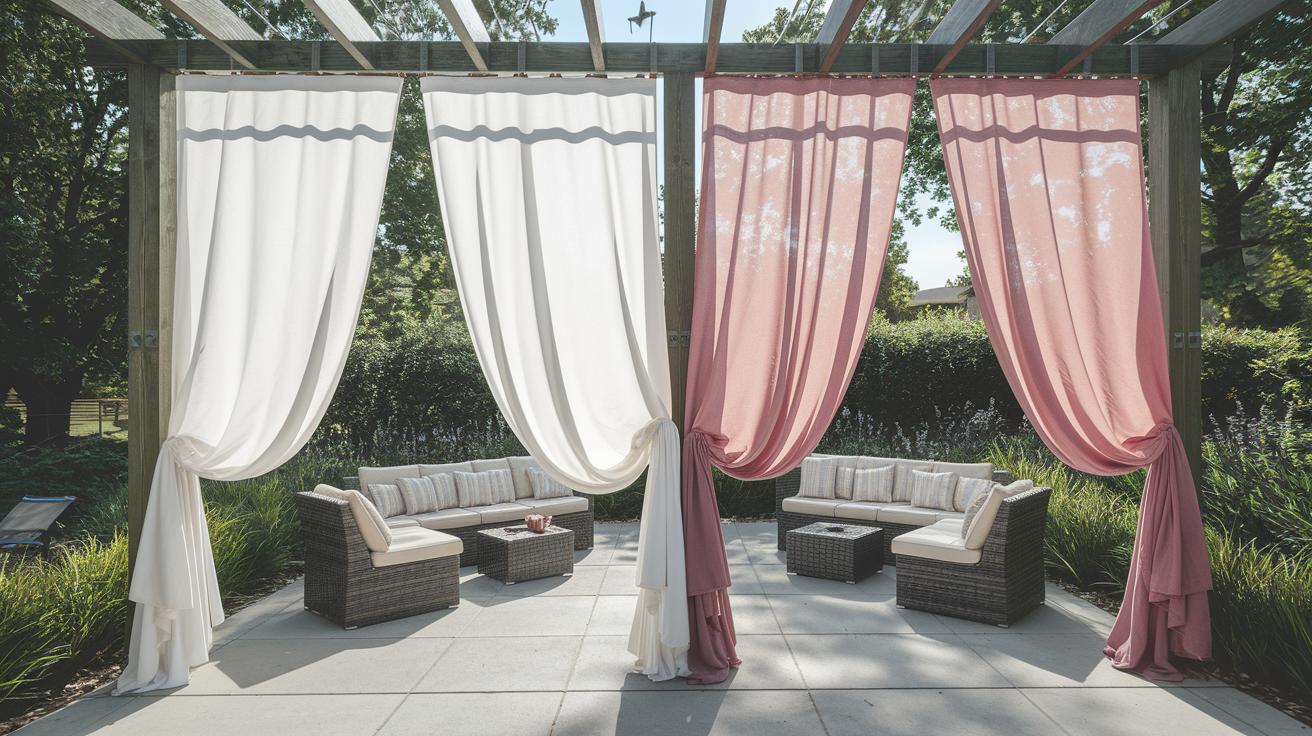
Think in tiers rather than price tags. The $ tier gets you outdoor-rated polyester and sheers — a fine way to test whether curtains suit your patio before committing, with the understanding that color will fade in a few seasons. The $$ tier is waterproof triple-weave territory, where most patios should land: real sun-blocking, real rain resistance, machine-washable. The $$$ tier is solution-dyed acrylic like Sunbrella, which costs more upfront and then outlasts two or three rounds of budget panels — the arithmetic quietly favors it if you plan to keep the patio dressed for years. Whatever the tier, buy one panel first. Confirm the color in your own light — screens flatter every fabric — and that your hardware plan works, then order the rest.
And if you’ve read this far suspecting curtains aren’t quite your answer, three neighbors are worth knowing. Roll-down exterior screens handle wind and storms far better and disappear when retracted. Clear vinyl panels are the restaurant-patio solution for true year-round protection, at the cost of that soft, moving-fabric feel. Shade sails give sculptural overhead sun control with zero privacy. Plenty of patios end up layered — curtains for daily softness and privacy, one rigid solution on the weather side — and since curtains dress the same structures our guide to durable patio lounge chair materials covers, the same buy-once logic applies across the whole setup.
A Simple Plan for Your First Set of Curtains
Here’s how I’d start this weekend. Pick your fabric by climate — triple-weave polyester for most yards, acrylic if you’re buying once, waterproof if storms roll through regularly. Measure your span, multiply by 1.5 to 2 for fullness, and choose the simplest hardware your structure allows: a rustproof rod for most, cable for long spans, tension rods if you can’t drill. Order a single panel, live with it for a week, then finish the opening.
Do one opening before you do three. The first evening the light comes through that fabric — moving a little, glowing a little — you’ll know exactly how much more of it you want. Of everything I’ve added to my own patio over the years, no single change has shifted the feel of the space more per dollar than the curtains.
Recommended gear for this project
As an Amazon Associate, Backyard Superstar earns from qualifying purchases at no extra cost to you.
- Top pick — RYB HOME waterproof outdoor curtains (2 panels) ($$). Triple-weave sun blocking, sheds rain, machine washable — the sensible default for most patios.
- Budget pick — BONZER white outdoor sheer curtains (2 panels) ($). Soft filtered light and breeze-friendly privacy for the least money.
- Premium pick — Sunbrella Canvas outdoor curtain with nickel grommets ($$$). Solution-dyed acrylic that holds its color for years — buy once.
- For windy patios — RYB HOME windproof curtains with weight bags (2 panels) ($$). Sewn-in hem weights keep panels swaying instead of flying.
- Long spans — RYB HOME rustproof outdoor curtain rod (up to 168″) ($$). Heavy-load rated and coated against the weather.
- Standard openings — Kenney Weaver rust-resistant curtain rod ($). A solid, simple rod for covered porches and window-width spans.
Common Questions About Outdoor Patio Curtains
What is the best fabric for outdoor patio curtains?
Solution-dyed acrylic (Sunbrella and similar) is the most durable choice — the color is locked into the fiber, so it resists fading and mildew for years. Waterproof triple-weave polyester is the practical middle ground, and outdoor-rated polyester or sheers are the budget-friendly starting point, with the tradeoff of faster fading.
How wide should outdoor patio curtains be?
Plan for 1.5 to 2 times the width of your opening so the panels hang with proper fullness. A 10-foot span wants 15 to 20 feet of total fabric width, which usually means four standard 50- to 54-inch panels. For length, 84, 96, and 108 inches are the standard drops.
How do I keep outdoor curtains from blowing in the wind?
Weight the hems — either panels with sewn-in weight bags or clip-on drapery weights added to curtains you already own. Heavier fabrics like acrylic and triple-weave polyester flap less than sheers, and tiebacks tame open panels. On sites that are windy every day, a rigid roll-down screen outperforms any curtain.
How do you hang curtains on an outdoor patio?
Mount a rustproof rod to a wall, pergola beam, or porch frame with outdoor-rated brackets and stainless or galvanized screws, then thread grommet-top panels onto the rod. Long spans do better on a taut stainless cable, and renters can use spring-tension rods that wedge between surfaces without drilling.
How do I clean outdoor patio curtains?
Follow the fabric: polyester and triple-weave machine wash on cold and gentle, solution-dyed acrylic hand washes in cool soapy water, canvas is spot-clean only, and coated waterproof fabrics wipe down. Wash every three to six months in season, treat for mildew in humid climates, and store panels indoors over the off-season.
Are outdoor curtains worth it?
For most patios, yes — they soften harsh sun, add real privacy, and change the feel of the space more than almost any other single purchase. They’re the wrong tool for constantly windy sites or for true year-round weather protection, where screens or clear vinyl panels do the job better.