Bamboo Garden Ideas for Privacy and Pathways
The first bamboo I ever planted was a running Phyllostachys a neighbor divided for me, and I spent the next three summers apologizing to my vegetable bed for it. That experience taught me the most important rule of bamboo garden ideas: the variety you choose matters more than anything you do after planting. Get that one decision right and bamboo becomes one of the most rewarding structural plants a home gardener can grow — a rustling privacy screen, a low-maintenance border, a tropical focal point, or raw material for garden projects.
Here’s how I think through the decisions that actually matter: clumping versus running types, species selection for your zone, privacy and pathway applications, and the seasonal maintenance that keeps a planting looking intentional instead of wild.
As an Amazon Associate, Backyard Superstar earns from qualifying purchases at no extra cost to you.
Clumping vs. Running Bamboo and Why It Matters
Before you fall in love with any particular bamboo, you need to understand the split between clumping and running types, because getting this wrong is the source of nearly all bamboo regret — mine included.
Clumping bamboo (genera like Bambusa, Fargesia, and Chusquea) expands outward slowly from a central crown, adding a few inches of diameter a year. It stays where you put it. That makes it the right choice for borders, containers, accent plantings, and honestly for most residential gardens, period.
Running bamboo (primarily Phyllostachys) is a different animal. It sends horizontal rhizomes several feet from the parent plant every season, which is wonderful when you need to screen a long boundary quickly and a genuine problem everywhere else. The catch is containment: a running variety needs a physical root barrier of at least 60-mil high-density polyethylene buried at least 24 inches deep around the entire planting area. In my own garden I now ring every runner with Bamboo Shield 24-inch root barrier ($$$) — it’s the one purchase that turns running bamboo from a liability into a design tool.
| Clumping bamboo | Running bamboo | |
|---|---|---|
| Spread | A few inches per year from the crown | Rhizomes travel several feet per season |
| Containment | None needed | 60-mil HDPE barrier, 24+ inches deep |
| Best for | Borders, containers, small gardens | Large-scale screening with barriers |
| Cold-hardy pick | Fargesia robusta, F. nitida | Phyllostachys bissetii |
Climate matters just as much as habit. Fargesia species are the cold-hardy champions among clumpers, shrugging off temperatures well below 0°F and suiting Zone 5 gardens. Bambusa varieties want Zone 8 or warmer. Check your USDA hardiness zone before you buy anything, because a bamboo that dies back to the ground every winter never builds the height you planted it for.
Choosing the Right Bamboo for Your Garden
Varieties differ enormously in mature height, cane diameter, leaf density, and light needs, so narrow the list by what you want the plant to do.
For privacy screens, you want height and leaf density. Phyllostachys nigra — black bamboo — is beloved for its glossy dark culms and reaches 20 to 25 feet in warm climates, though it runs and needs barriers. Among the well-behaved clumpers, Bambusa oldhamii can hit 20 to 55 feet where frost is rare, and for colder zones Fargesia robusta ‘Campbell’ grows 12 to 15 feet and keeps its leaves through winter, which is exactly what you want standing between your patio and the neighbor’s deck in January.
For containers and small gardens, dwarf clumpers like Bambusa multiplex ‘Tiny Fern’ or Fargesia nitida stay compact. A container is also the honest way to grow a runner in a small space — the pot is its own root barrier.
For light and soil: most bamboos want six or more hours of sun, though the Fargesias actually prefer some afternoon shade. All of them want well-draining, slightly acidic soil. Waterlogged ground is the fastest way to yellow leaves and rotted roots.
Using Bamboo for Garden Privacy Screens
Privacy is why most people call me about bamboo, and it delivers. A well-placed screen blocks a sightline, muffles street noise, and gives the rest of the garden a green backdrop that makes everything planted in front of it look deliberate. The evening light coming through a bamboo screen — soft, green, moving — is something a fence will never give you.
For a hedge, plant clumping bamboo in a single row, spaced three to six feet apart depending on the variety’s mature width. It will look sparse the first two years; by year three it fills convincingly. If you can’t wait, plant denser and thin later.
Think about what the screen shades as it grows. Set it on the north or east side of a seating area where you can, so it doesn’t steal sun from a vegetable plot. And if the screen doubles as a backdrop for ornamental planting along a boundary, our guide to fence line garden ideas covers how to layer plants against it effectively.
Bamboo Edging and Pathway Ideas
Bamboo also earns its place at ground level. As an edging material it complements both rustic and contemporary gardens, and left untreated it weathers to a soft silver-grey that I like better than the original gold.
Split bamboo roll edging is the easiest to install — stake the roll along the bed line and you’re done, though expect to replace it every three to five years as it weathers. For taller definition or a screen-backed bed, rolled fencing panels like Backyard X-Scapes natural rolled bamboo fencing ($$) attach directly to posts or an existing chain-link fence and instantly read as a finished garden wall.
Upright stake borders suit a Japanese or contemporary garden: canes of varying heights driven six to eight inches into the soil along a path. A bag of Bond 4-foot natural bamboo stakes ($) is the inexpensive way to experiment before committing — and use a rubber mallet on the culm tops, never a steel hammer, or they split.
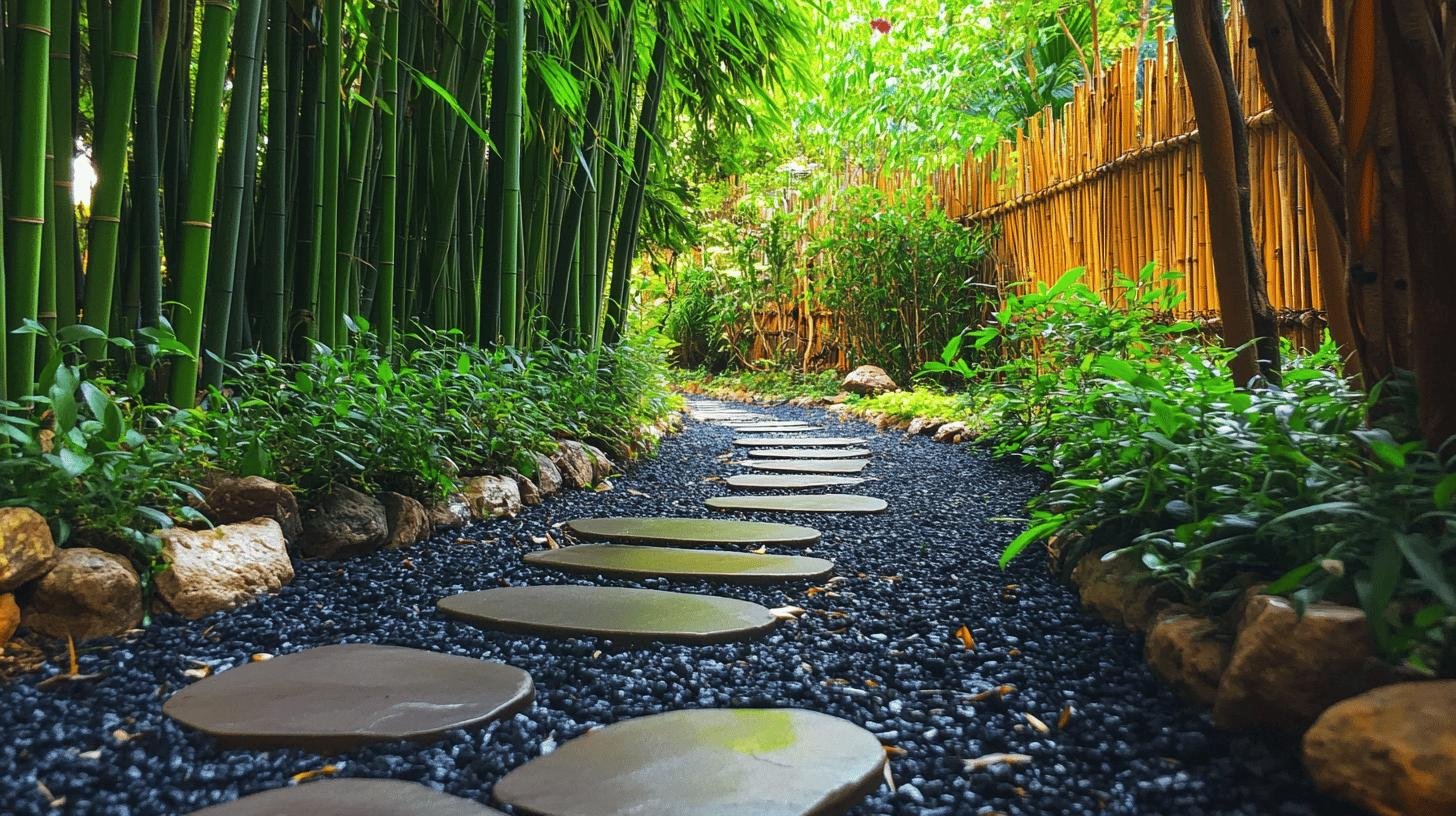
For the pathway itself, bamboo works as stepping-stone borders, or as an overhead canopy when tall varieties arch from both sides of a narrow walk. Paired with gravel it’s classic — just plan for weeds in the gravel from day one (our gravel garden weed guide covers that battle) — and if stone is your material of choice, bamboo makes a striking vertical counterpoint in the layouts from our rock garden ideas guide.
DIY Bamboo Projects for the Garden
Once a clump matures you can harvest culms from your own garden, which is where bamboo becomes genuinely fun. It’s hollow, light, strong, and cuts cleanly, and a surprising number of garden structures come together from it in an afternoon.
A trellis is the classic first project: three or four poles lashed into an A-frame or teepee with jute twine takes under an hour and will carry pole beans, cucumbers, or a Thunbergia through the season. Off-cuts become plant markers, wind chimes with a warmer tone than any metal set, or legs for a potted-plant riser. The ambitious project is a water feature — a drilled bamboo spout running over a basin of stones gives you the classic shishi-odoshi sound, and the gentle knock of it is half the reason my back corner feels like a tranquil space at all.
Pairing Bamboo with Companion Plants
A bamboo clump by itself can read as a green monolith, especially in a small garden. The fix is what you plant at its feet.
Low groundcovers — creeping thyme, sweet woodruff, Japanese forest grass — tolerate the dappled shade under a mature clump, hide the bare soil, and suppress weeds without competing hard for nutrients. Choosing the right one is its own small decision; our guide to choosing ground cover for your backyard walks through the options. Between clumps, hostas, astilbes, and ferns bridge the visual gap and thrive in the part shade bamboo creates.
The traditional Japanese pairing skips plants entirely: a gravel apron, a few stepping stones, one good boulder, and the bamboo is the star. In a contemporary garden this restraint works beautifully. One caution from experience — established bamboo is thirsty, so keep moisture-loving perennials out of its immediate root zone and maintain a 12-inch mulch ring around the base, or both plants sulk.
Maintaining Your Bamboo Garden
Bamboo isn’t maintenance-free, but the list is short and the rhythm is seasonal.
Water new plantings consistently for their first two growing seasons. After that, most bamboo rides out dry spells better than the rest of the garden, though yellowing leaves in a drought are its way of asking for a deep soak.
Feed with a nitrogen-rich fertilizer in spring and again in midsummer — bamboo is a grass, and it eats like one. I broadcast Milorganite 6-4-0 slow-release fertilizer ($) around my clumps because the slow nitrogen release matches how bamboo takes it up, and it won’t burn if I’m generous. Skip feeding after late summer, since tender fall growth is the first thing frost takes.
Thin annually. Culms reach full height in a single season, mature for two or three years, and start looking weathered around year five or six. Each spring I cut the oldest, dullest 20% at the base with a pair of Fiskars 28-inch Power-Lever bypass loppers ($$) — established culms are tougher than they look, and the compound leverage saves your forearms. The clump that gets thinned every year is the one that stays healthy, lets light into its center, and keeps sending up strong new shoots.
And keep walking the perimeter. Even clumpers expand; shoots emerging where you don’t want them pull easily while soft. For runners behind barriers, inspect the barrier line once a year and cut back any rhizome trying to climb over the edge.
Troubleshooting Common Bamboo Problems
Yellow leaves are the most common complaint, and the cause is almost always one of three things: drought stress, nitrogen hunger, or wet feet. Check soil moisture first. Bone dry means water deeply once a week; consistently soggy means the drainage needs fixing; if it’s neither, feed it.
Sparse or thin growth usually signals too little sun, or a clump past its tenth year that wants dividing — dig and replant the vigorous outer sections and let the center recover. Black or grey spots on culms are mostly cosmetic fungal marks; cut out any collapsing canes and thin for airflow. And a single culm browning while its neighbors stay green is usually just old age — most culms live seven to ten years. Cut it at the base and move on. Several dying together is the one that warrants a root-rot check.
Recommended gear for this project
As an Amazon Associate, Backyard Superstar earns from qualifying purchases at no extra cost to you.
- Top pick — Bamboo Shield 50 ft × 24 in, 60-mil root barrier ($$$). The containment insurance that makes running bamboo plantable at all.
- Budget pick — Bond natural bamboo stakes, 4 ft (25-pack) ($). Path borders, trellis frames, and plant supports from one cheap bag.
- Premium pick — Backyard X-Scapes rolled bamboo fencing, 4 ft × 8 ft ($$). Instant garden wall for screens and bed backdrops.
- Feeding — Milorganite 6-4-0 slow-release fertilizer, 32 lb ($). Slow nitrogen that matches how this giant grass eats.
- Thinning — Fiskars 28″ Power-Lever bypass lopper ($$). Compound leverage for the spring culm-thinning that keeps clumps healthy.
Bamboo Garden FAQ
How do you start a bamboo garden?
Choose a spot with six or more hours of sun (part shade for Fargesia varieties) and well-draining soil, and pick a clumping variety suited to your USDA zone. Dig a hole twice as wide as the root ball and the same depth, backfill with native soil amended with compost, water deeply, and mulch. Spring planting after the last frost gives the best establishment.
Is bamboo good for a garden?
Bamboo is excellent when the variety matches the purpose: fast screening, year-round structure, and low maintenance once established. The one caveat is that running bamboo needs a buried root barrier to prevent invasive spread. Choose a clumping variety and bamboo is one of the easier structural plants to manage.
How do you maintain a bamboo garden?
Water consistently for the first two years, feed with a nitrogen-rich fertilizer in spring and midsummer, and thin the oldest culms each spring. For running bamboo, inspect the root barrier annually and cut back escaping rhizomes. Pull unwanted shoots at the perimeter while they’re still soft.
What types of bamboo are best for landscaping?
Clumping varieties are best for most landscaping because they’re non-invasive. Fargesia robusta and Fargesia nitida suit cold climates; Bambusa multiplex and Bambusa oldhamii suit warm ones. Black bamboo (Phyllostachys nigra) is the dramatic exception people plant anyway — grow it in a container or behind a root barrier.
How do you use bamboo for garden privacy?
Plant a row of tall clumping bamboo at three to six foot spacing along the boundary you want to screen. Species like Bambusa oldhamii, or Phyllostachys bissetii with barriers, reach 15 to 20 feet and give year-round privacy within three to five years. Plant more densely for faster screening and thin once the hedge fills in.
What is the difference between clumping and running bamboo?
Clumping bamboo grows outward slowly from a central crown and stays put. Running bamboo spreads by underground rhizomes that travel several feet per season and becomes invasive without containment. For most residential gardens, clumping bamboo is the practical and responsible choice.
Can bamboo be grown in a small backyard?
Yes. Grow it in large containers — 20 gallons minimum for most varieties — which contain the roots naturally, or choose dwarf clumping varieties that stay under four feet. Even one container of bamboo adds a structural, softly moving element most other plants can’t match.