20+ Backyard Games for Kids of Every Age
Getting kids outside doesn’t require a swing set or an expensive playground — I’ve watched a flat patch of grass and a box of sidewalk chalk hold a group of eight-year-olds longer than any screen. This guide covers more than twenty backyard games for kids, grouped by type: classic lawn games, water play for hot days, creative activities, weather-flexible options, and traditional games that work when the ages span from preschool to grandparents. At the end there’s a practical framework for planning a full game day, because the difference between a magical afternoon and a meltdown is usually twenty minutes of prep.
As an Amazon Associate, Backyard Superstar earns from qualifying purchases at no extra cost to you.
Classic Backyard Games Every Kid Should Know
Some games have survived for generations because they simply work: easy to explain, no equipment budget, and they scale as more kids arrive. These are the ones I teach first.
Capture the Flag is the gold standard for large groups and kids eight and up. Divide players into two teams, each with a flag — a bandana works — hidden in their territory. The goal is to cross into enemy territory, grab the flag, and get home without being tagged. Tagged players wait in “jail” until a teammate frees them. Games run twenty to thirty minutes and absorb as many players as show up, which is exactly what you want at a birthday party.
Duck Duck Goose is the reliable pick for the four-to-seven crowd. Players sit in a circle while one child circles them, tapping heads and saying “duck” until choosing a “goose,” who leaps up and gives chase. Simple, high-energy, endlessly repeatable — and the giggling is half the point.
Red Light, Green Light works across a wide age range with zero equipment. One player is the traffic light; everyone else starts at a line twenty to thirty feet back. The light faces away and calls “green light,” then spins around on “red light.” Anyone caught moving goes back to the start. First to tag the light wins, and younger kids genuinely can beat older ones, which keeps everybody in it.
Hopscotch builds balance and number sense at the same time. Draw a numbered grid with chalk and let kids take turns tossing a marker and hopping the course. A big bucket of Crayola Washable Sidewalk Chalk (48 count) ($) is the single most-used piece of game gear at my house — it draws the hopscotch grid, the game-boundary lines, the four-square court, and the finish line for every relay, then washes off with the hose.
Simon Says needs no setup at all. One player issues commands prefaced with “Simon says”; follow a command without the magic words and you’re out. I use it as a transition game — it settles a wound-up group between bigger activities.
Water Games for Hot Days
When July gets serious, water games earn their spot at the top of the roster. A few buckets, a hose, and some balloons are genuinely all you need, and the cooling-off is built into the fun.
Sprinkler Tag is exactly what it sounds like: set an oscillating sprinkler in the middle of the yard and play tag through it. Getting caught by the spray can count as a tag if you want another layer. Best for kids six and up who don’t mind being soaked to the skin.
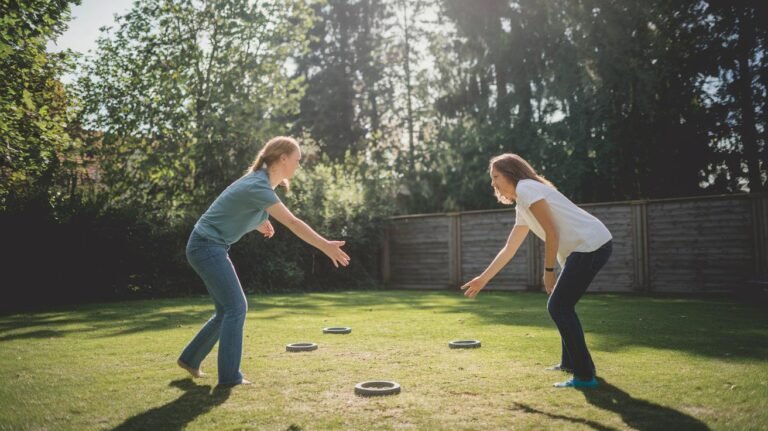
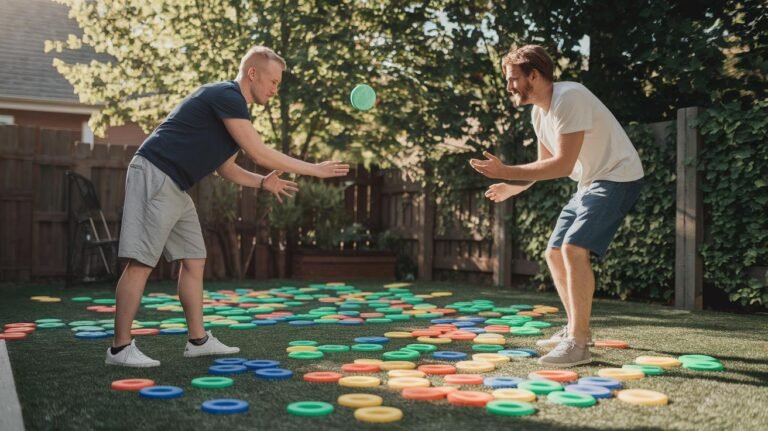
Water Balloon Toss is a partner game that fills a happy twenty minutes. Pairs toss a balloon back and forth, stepping back after each catch; the last pair with an intact balloon wins. The bursts are most of the entertainment. The prep used to be the miserable part — filling and tying a hundred balloons one at a time — which is why self-sealing bundles like Bunch O Balloons (420 count) ($) changed my summers: a stem fills dozens at once off the hose and they seal themselves. Pick up the burst scraps afterward — they’re not something you want the lawnmower or the dog finding.
Slip and Slide takes a plastic sheet or tarp on a gentle slope, a running hose, and a squirt of dish soap if you’re feeling generous. Kids take running starts and slide the length of it. Walk the slope first for rocks and sprinkler heads, keep the surface wet, and hold this one for ages six and up.
Cup Relay Race splits kids into teams: run to a bucket, fill a small cup, carry it back, pour it into your team’s container. First team to the fill line wins. The spillage is the comedy.
Sponge Bombs are my favorite water-balloon alternative because they’re reusable: cut large sponges into strips, bundle several strips, and cinch the middle with a rubber band to make a soft, throwable ball. Soak and throw — at targets, at each other, in relays — then leave them in the sun to dry for next time.
Creative Outdoor Activities for Children
Not every backyard activity has to be competitive. Creative play builds observation and fine-motor skills, and it gives the quieter kids in a group a place to shine. I run these as warm-ups before structured games or as the wind-down at the end of the day.
Nature Scavenger Hunt is the easiest to set up: list natural finds — a smooth rock, a seed pod, something yellow, a feather, a Y-shaped twig — and send kids hunting. Younger children work from picture lists; older ones keep score. If your crew takes to it, our backyard scavenger hunt guide has themed lists and clue ideas ready to print.
Rock Painting needs flat rocks, acrylic craft paint, and brushes. Kids paint faces, patterns, and tiny scenes, then keep them as garden decorations or hide them around the neighborhood for strangers to find — which they find thrilling.
Leaf Rubbings need only paper and crayons. Leaf face-down under the paper, rub the crayon’s side across the top, and the veins print through in detailed relief. Comparing rubbings from different trees quietly turns it into a botany lesson.
Nature Crafts are best kept loose: set out glue sticks, cardstock, string, and tape, and let kids build with whatever the yard offers. Stick frames, grass weaving, pressed-flower collages — the results beat any prescribed craft kit, every time.
Weatherproof Games for Covered Spaces
A covered patio, garage, or carport keeps game day alive in weather that would otherwise cancel it. These options move between sheltered outdoor space and the living room without missing a beat.
Indoor Hopscotch swaps chalk for painter’s tape on any hard floor. Same rules, and the tape peels up cleanly afterward.
Bean Bag Toss can be as simple as a cardboard box with holes cut in it — or a proper set that lasts for years of parties. A foldable regulation set like the GoSports Cornhole PRO set ($$) folds flat to carry, sets up on any surface, and the distance and scoring scale down easily for small kids. Ours lives against the garage wall and comes out for everything from playdates to Thanksgiving.
Tabletop Tic-Tac-Toe scales up nicely: draw a large grid on a vinyl tablecloth and use two sets of colored stones or bean bags as Xs and Os. Setup takes two minutes and it packs flat.
Balloon Games shine under a roof: balloon volleyball over a string, balloon stomp (a balloon tied to each ankle, protect yours while popping everyone else’s), and keep-away all work in a carport.
Traditional Lawn Games for Mixed Ages
Traditional lawn games were built for mixed-age groups — mechanics a six-year-old can grasp, with enough skill to keep the adults honest. They’re the backbone of family reunions for a reason.
Bocce Ball has players tossing weighted balls to land closest to a smaller target ball, the pallino. Scoring is intuitive and a good roll from a kid beats a lazy one from an adult. The GoSports 90 mm Backyard Bocce Set ($$) is the one I recommend most for families — 90 mm balls are sized and weighted so small hands can actually throw them, and the set packs into its own case with a measuring rope that ends the “mine’s closer!” arguments.
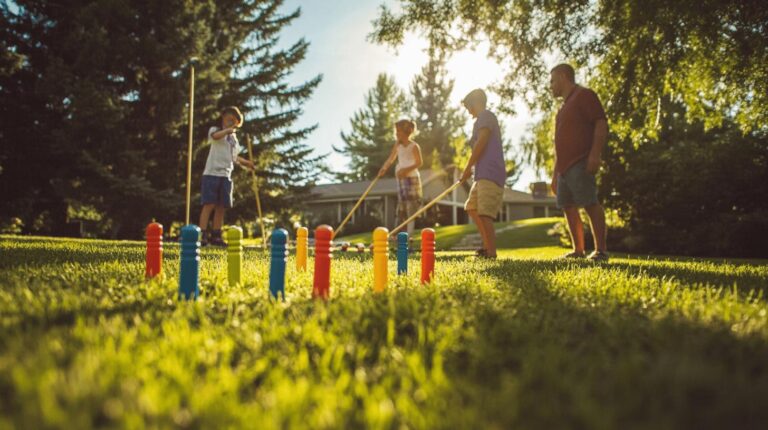
Croquet tests patience and coordination as players mallet balls through a course of wickets. Kids as young as six can play with a little guidance. A six-player set like the ApudArmis 35-inch Croquet Set ($$) covers a whole birthday party in one bag, and the longer mallets save adult backs. New to the game? Our beginner croquet rules and setup guide walks through the course layout in plain English.
Horseshoes needs two stakes, twenty to forty feet apart depending on ages, and shoes tossed for ringers and proximity. For kids I always point families to a rubber horseshoe set ($) — soft shoes and surface mats mean no bruised shins and no lawn craters, and it moves indoors in winter. The full rules, distances, and scoring live in our horseshoes setup and scoring guide.
Giant Tumbling Tower is the newest “traditional” game on my list because it behaves like one: slow, suspenseful, and multigenerational. The GoSports Giant Wooden Toppling Tower ($$$) starts at about 2.5 feet and grows past 5 feet in play — the collective gasp when it finally crashes is worth the price of admission. Play it on grass, keep toes clear, and stack the first rows on a flat paver or board so the tower starts level.
Planning a Successful Backyard Game Day
The difference between a game day that flows and one that dissolves into squabbles is usually planning — not rigid scheduling, just enough structure that transitions are smooth and nobody’s left out.
Build a loose schedule. Two or three structured blocks of twenty to thirty minutes each, with snack breaks and free play between. I start with a big team game like Capture the Flag while energy is high, shift to water games mid-afternoon, and land on a calm creative activity — that arc mirrors how kids’ energy actually runs.
Match games to ages. With a wide age span, run parallel activities so the little ones aren’t perpetually losing to the big ones. A craft table running alongside a competitive game gives younger kids a real choice instead of a consolation prize.
| Game | Best ages | Duration | Equipment needed |
|---|---|---|---|
| Capture the Flag | 8+ | 30 min | 2 flags or bandanas |
| Duck Duck Goose | 4–7 | 15 min | None |
| Water Balloon Toss | 6+ | 20 min | Water balloons |
| Hopscotch | 5–10 | 15 min | Chalk or tape |
| Simon Says | 4–10 | 10 min | None |
| Bocce Ball | 6+ | 30 min | Bocce set |
| Slip and Slide | 6+ | 45 min | Tarp, hose |
| Nature Scavenger Hunt | 4–12 | 20 min | List, bags |
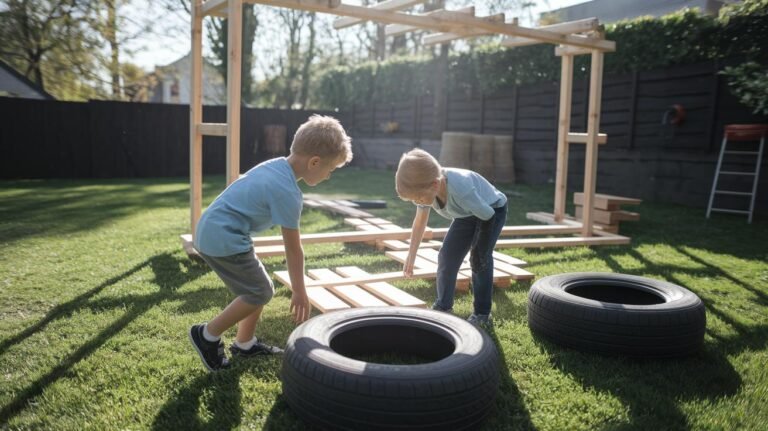
Prepare the space. Clear tripping hazards, mark boundaries with chalk or cones, and set up a shaded rest area with water and snacks where supervising adults can see everything without hovering. If your crew is the type that wants more of a challenge course, our guide to building a backyard obstacle course shows how to turn the same yard into a full circuit.
Plan themed snacks. Small details are what kids retell later: red and blue popsicles on Capture the Flag day, watermelon for water games, fruit skewers arranged as “swords” for a knights theme.
Designate helpers. Teenagers make excellent team captains and referees. A defined job keeps them engaged instead of drifting to their phones, and it genuinely lightens your load.
Safety Considerations for Active Outdoor Play
Most backyard games are low-risk, but a few minutes of prep prevents the small injuries that end an afternoon early.
Walk the yard first. Pick up rocks, sticks, hose nozzles, and abandoned toys; check for holes from digging dogs or settling soil; flag sprinkler heads if kids will be sprinting.
Set ground rules for fast games. Before tag or Capture the Flag, agree on boundaries, define safe zones, and remind everyone hands stay off faces. A thirty-second briefing prevents most mid-game disputes.
Schedule water breaks in heat. Kids running in summer sun rarely stop on their own — set a timer for a break every twenty to thirty minutes. A pitcher and cups in the shade works better than handing out bottles, which end up half-drunk all over the lawn.
Don’t skip sun protection. Sunscreen fifteen minutes before play, reapplied every couple of hours and after water games. A bin of inexpensive bucket hats by the back door makes hats the default instead of a negotiation.
Keep a basic first-aid kit findable. Bandages, antiseptic wipes, and an ice pack in the freezer cover nearly every backyard scrape. Knowing exactly where the kit lives matters more than what’s in it.
Backyard Games for Kids FAQ
What are the best backyard games for kids?
It depends on the group’s ages and energy. For mixed ages, Capture the Flag and bocce work well because they accommodate different abilities. For younger children, Duck Duck Goose and hopscotch are reliable. On hot days, water balloon games and a slip and slide are consistently the favorites.
What outdoor games can kids play without any equipment?
Tag, Hide and Seek, Red Light Green Light, Simon Says, and Duck Duck Goose need nothing at all. They start spontaneously, take any number of players, and work in a big yard or a small one.
What are five fun outdoor games for a family game day?
A well-rounded lineup: Capture the Flag (team energy), a nature scavenger hunt (creative and exploratory), Water Balloon Toss (wet and silly), bocce (multigenerational), and a homemade obstacle course (active and collaborative). Together they cover every energy level in the group.
What yard game works for both kids and adults?
Bocce and croquet are the most multigenerational — genuinely engaging for adults while kids join with basic instruction. Horseshoes works too; rubber sets suit younger children. All three generate conversation and friendly competition without needing speed.
How do I set up DIY outdoor games on a budget?
Hopscotch takes only sidewalk chalk. A slip and slide is a tarp and a hose. Sponge bombs are sponges and rubber bands. A bean bag toss board can be a cardboard box with holes cut in it, and scavenger hunts are free. A single small budget covers materials for most of the games in this guide.
What are weatherproof alternatives when it rains?
A covered patio or garage keeps most of these going: taped-floor hopscotch, bean bag toss, tabletop tic-tac-toe, and balloon games all work under a roof. If the weather forces everyone fully inside, most adapt to a basement or living room with minimal changes.
How do I plan a backyard game day for a group of kids?
Build a loose schedule of two or three activity blocks separated by snack breaks, match games to the age range, and give an older child or adult helper a defined role managing transitions. Prepare the space beforehand — clear the yard, mark boundaries — keep water and snacks reachable, and leave room for free play so kids who want to set their own agenda can do it without derailing the plan.
Recommended gear for game day
As an Amazon Associate, Backyard Superstar earns from qualifying purchases at no extra cost to you.
- Top pick — GoSports 90 mm Backyard Bocce Set ($$). Family-sized balls small hands can throw, with a case and measuring rope that settles every argument.
- Budget pick — Crayola Washable Sidewalk Chalk, 48 count ($). Draws the hopscotch grid, boundaries, and finish lines for half the games here, then hoses off.
- Premium pick — GoSports Giant Wooden Toppling Tower ($$$). Stacks past five feet, plays slow and suspenseful, and pulls in every generation at the party.
- Hot-day hero — Bunch O Balloons, 420 count ($). Self-sealing stems fill dozens of water balloons at once — the prep bottleneck, solved.
- Party staple — GoSports Cornhole PRO set ($$). Regulation boards that fold flat, set up anywhere, and scale down for small kids.
- Mixed-ages classic — ApudArmis 35-inch Six-Player Croquet Set ($$). Six mallets covers the whole party, and the longer handles spare adult backs.
- Kid-safe option — Rubber horseshoe set ($). Soft shoes and mats: no bruised shins, no lawn craters, works indoors in winter.