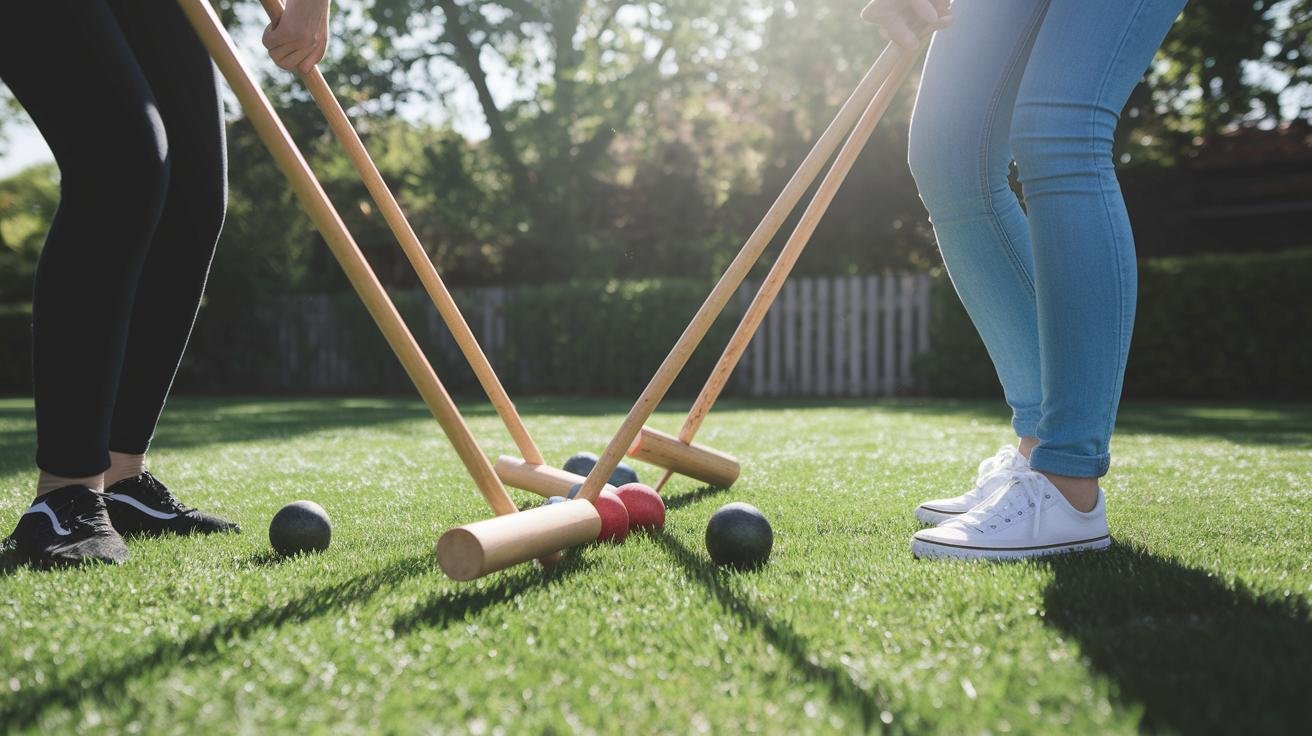
Beginner Croquet Rules and Backyard Setup
Croquet looks genteel until someone sends your ball halfway across the yard with a single tap — then it gets competitive fast. That’s the whole appeal. The gear is simple, the rules take about five minutes to learn, and a single set can pull a backyard full of people into a game that spans ages eight to eighty. If you’ve got a patch of grass and a free afternoon, you can be playing today. Here are the beginner croquet rules and the backyard setup, start to finish, the way I’d explain it to a neighbor over the fence.
As an Amazon Associate, Backyard Superstar earns from qualifying purchases at no extra cost to you.
What You Need to Play Croquet
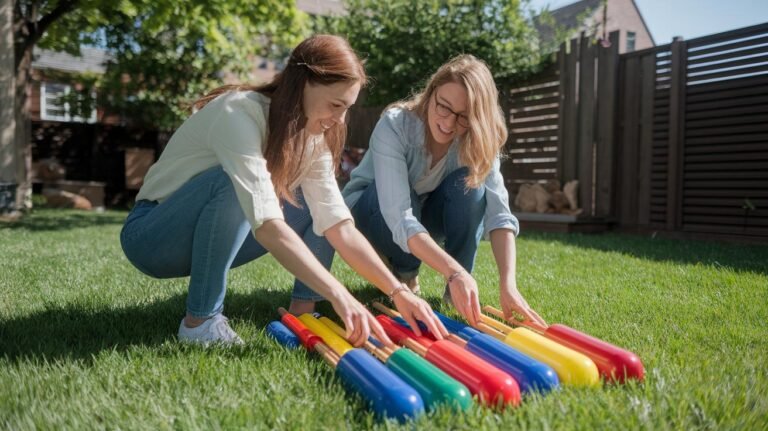
The good news: croquet is close to plug-and-play. A standard set comes with everything you need in one bag — six mallets, six balls in matching colors, nine wickets (the metal hoops the balls pass through), and two stakes. That’s the entire kit. You supply the lawn.
For most families, a six-player set is the sweet spot, because it covers a full game with friends but plays just fine with two. A solid all-around choice is the GSE Games 36-inch Deluxe Six-Player Croquet Set, which gives you full-length hardwood mallets and a carrying bag that keeps the whole thing organized in the garage ($$). The longer 36-inch handle matters more than people expect — short mallets have you hunched over like you’re weeding, while a full-length handle lets you stand tall and swing like a pendulum.
If you just want to try the game without much outlay, the Amazon Basics Six-Player Croquet Set covers the basics with wooden mallets and a carry case for not much money ($). It won’t last decades, but it’ll get a season or three of weekend games out of it, which is plenty to find out whether croquet earns a permanent spot in your yard.
On the other end, if you’ve caught the bug and want a set that plays true and looks the part, the Wood Mallets Hurlingham Six-Player Croquet Set is built to a higher standard — heavier, better-balanced mallets and balls that roll dead straight ($$$). It’s the kind of set you hand down rather than replace. If you’re weighing where on that range to land, the guide to choosing a lawn croquet set breaks down what actually separates the tiers.
Two quick notes on fit. First, if your group is usually four people or your yard is on the smaller side, a four-player kit like the Wood Mallets Premium Four-Player Croquet Set packs lighter and stores smaller without giving up quality ($$). Second, mallet weight changes how the game feels — heavier heads drive the ball with less effort but are harder to finesse, while lighter ones reward a delicate touch. If anyone in the house is picky about that, the mallet weight comparison is worth a look before you buy.
How to Set Up a Backyard Croquet Court
Backyard croquet uses the classic nine-wicket, two-stake layout. Picture a long rectangle with the nine wickets arranged in a double-diamond pattern and a stake at each end on the center line — one is your starting and finishing stake, the other is the turning stake at the far end. A regulation court runs 100 feet by 50 feet, but almost nobody has that, and you don’t need it. Scale the whole thing down to fit your grass; even a 30-by-60-foot stretch makes a fun game.
The fastest way to lay it out evenly is to measure rather than eyeball. A long open-reel tape like the Komelon 100-Foot Open-Reel Fiberglass Tape Measure lets one person stretch a clean line down the center while another places the stakes and wickets ($). Set your two stakes first, on the center line, then place the wickets symmetrically off that line so both diamonds match. For the exact spacing and the full diagram, the court dimensions guide has it drawn out — keep that open on your phone the first time.
Wickets need to stand firm. Push each one straight down until the crown sits low and the legs are deep enough that a passing ball won’t knock it crooked. A wobbly wicket turns a fair shot into a coin flip. If your soil is hard, wet it down an hour before you set up, or tap the wickets with the side of a mallet to seat them — just don’t pound the tops flat.
Boundaries are the last piece, and the part most backyard games skip to their regret. Without a marked edge, every close call turns into an argument. A pack of Anley landscape marking flags makes quick, visible corners and sidelines that push right into the turf and pull back out when the game’s over ($). Mark the four corners at a minimum; flag the sidelines too if your yard slopes toward a flower bed you’d rather not chase balls into. And mow the playing area short and even the day before — croquet rolls best on a tight, dry lawn, and a fresh cut takes the luck out of it.
Croquet Rules for Beginners
Here’s the whole game in one breath: each ball has to pass through all nine wickets in the right order, in both directions, and then hit the finishing stake. First side to get its ball (or balls) all the way around and staked out wins. Everything else is detail.
Order of play follows the colors painted on the stake, top to bottom — blue, red, black, yellow, and then green and orange if you’re running six balls. Play always goes in that sequence, so you take your turn when your color comes up, then wait for it to roll back around. Each player starts by placing their ball a mallet’s length in front of the starting stake and playing it through the first wickets from there.
A turn is simple to start: you get one stroke. Step up, line up your mallet behind your ball, and swing through it like a pendulum — most of your control comes from a smooth, straight follow-through, not from hitting harder. Strike only your own ball with the face of the mallet; pushing, scooping, or double-tapping is a foul, and the penalty in friendly games is just losing the rest of your turn.
The reason croquet gets interesting is that you can earn extra strokes during your turn, and a good player chains those together to travel halfway around the court in one go. That’s the next section.
How a Turn Works: Wickets, Roquets, and Bonus Shots
You bank bonus strokes two ways during a turn.
Scoring a wicket. When your ball passes cleanly through the next wicket in its sequence, you earn one bonus stroke. Run two wickets back-to-back and you’ve earned two extra shots — that’s how a turn snowballs.
Roqueting another ball. If your ball hits another player’s ball, that’s a “roquet,” and it earns you two bonus strokes. The first of those two is special: it’s the croquet shot. You pick up your ball and place it touching the ball you just hit, then strike your own ball so both move. This is the heart of the game — you can use it to blast an opponent’s ball toward the woods, or to nudge your partner’s ball into a better spot, all while setting up your own next shot. After the croquet shot you get one ordinary “continuation” stroke to keep going.
One catch keeps it fair: you can roquet each other ball only once per turn. Hit blue, croquet it, and you can’t score off blue again — until you run your next wicket, which clears the slate and lets you roquet the whole field again. So the rhythm of a strong turn is roquet, croquet, run a wicket, roquet again, and so on. String enough of those together and you make what players call a break.
The turning stake at the far end is just a landmark — touching it doesn’t score and doesn’t cost you anything; you simply turn the corner and start working the wickets back the other way. Only the starting/finishing stake matters for ending a ball’s journey.
Winning the Game and Keeping Score
A ball that has passed through all nine wickets in both directions becomes a “rover.” A rover can still roquet other balls and still be roqueted, so it stays in the action right up until it finishes. To finish — “stake out” — the rover hits the finishing stake. That ball is now done and comes off the court.
The win condition depends on how you’re playing. In the traditional doubles game, four balls split into two teams of two (blue and black versus red and yellow), and the first team to stake out both of its balls wins — so helping your partner around the course with croquet shots is half the strategy. With a full six-player set, the easiest format for a crowd is cutthroat: everyone plays their own ball, and the first player to stake out wins, with the rest finishing for placing order if you like. Decide which version you’re playing before the first swing so nobody’s surprised when a “teammate” sends them packing.
You don’t need a scorecard for a casual game — the wickets a ball has cleared are easy to track by eye, and many sets include clips you can put on the wicket to show which ball is “for” it. If you want the broader menu of yard games to rotate through on game day, the roundup of classic lawn games pairs croquet nicely with the rest.
Simple Croquet Strategy for New Players
You can win plenty of backyard games on touch alone, but a few habits separate the people who finish from the people who wander.
Use roquets to travel, not just to attack. The temptation is to spend every croquet shot knocking opponents away, but the players who win use croquet shots to position their own ball in front of the next wicket. Send the other ball somewhere unhelpful and leave yourself a short, straight run — you get both.
Run wickets only when you’ve got a clean angle. A ball wedged against a wicket leg at a bad angle is a wasted stroke. If the angle’s ugly, it’s often smarter to roquet a nearby ball, take the croquet shot to reposition, and approach the wicket square on your continuation stroke.
Control beats power almost every time. Most missed shots in beginner croquet are overhits — the ball sails past the wicket or rolls out of bounds. Practice a soft, consistent tap on the flat part of the lawn before the game, and let the smooth swing do the work. In partner play, think a turn ahead: a short croquet shot that sets your partner up is worth more than a flashy long-distance blast.
Common Croquet Mistakes to Avoid
Most first-game frustration traces back to a handful of fixable things.
Loose wickets. If a ball can knock a wicket sideways, it’s not seated deep enough. Push them firmly into the ground before you start, and reseat any that work loose mid-game.
Running wickets out of order. Passing through a wicket only scores when it’s your ball’s next wicket in the sequence. Going through the wrong one doesn’t count, so know which hoop you’re aiming for before you swing.
Hitting too hard. Power feels satisfying and loses games. Overhit balls fly past wickets and off the court. Dial it back and aim for a controlled roll.
Ignoring boundaries. A ball that crosses the line is brought back in about a mallet-head’s length from where it went out, and in stricter rules your turn ends there. Decide your boundary rule up front — that’s exactly why you flagged the edges during setup.
Skipping cleanup. Wet balls and muddy mallets warp and crack over a season. Wipe everything down and store it dry; the croquet set maintenance tips cover keeping a good set playing true for years.
Recommended gear for backyard croquet
As an Amazon Associate, Backyard Superstar earns from qualifying purchases at no extra cost to you.
- Top pick — GSE Games 36″ Deluxe Six-Player Croquet Set ($$). Full-length hardwood mallets and a carry bag — the best all-around family set.
- Budget pick — Amazon Basics Six-Player Croquet Set ($). Covers the whole game cheaply so you can try croquet before committing.
- Premium pick — Wood Mallets Hurlingham Six-Player Set ($$$). Better-balanced mallets and true-rolling balls; a hand-it-down set.
- Smaller groups — Wood Mallets Premium Four-Player Set ($$). Same quality, lighter to store, ideal for tighter yards.
- Court layout — Komelon 100′ Open-Reel Tape Measure ($). Sets the wickets and stakes evenly so both diamonds match.
- Boundaries — Anley Landscape Marking Flags (100-pack) ($). Marks corners and sidelines so close calls aren’t arguments.
FAQ
How many people can play croquet?
Croquet works with two to six players. A standard six-ball set covers a full group but plays fine with just two. The traditional four-ball game is often played as doubles — two teams of two — while a six-player set is easiest as a cutthroat free-for-all.
How big should a backyard croquet court be?
A regulation court is 100 by 50 feet, but you can scale it to whatever grass you have. Even a 30-by-60-foot stretch makes a good game. Keep the double-diamond layout symmetrical and the lawn mowed short and even so the balls roll true.
What is the order of play in croquet?
Play follows the colors on the stake from top to bottom: blue, red, black, yellow, then green and orange when six balls are in use. You take your turn when your color comes up and then wait for the rotation to come back around.
How do you win a game of croquet?
Be the first to send your ball through all nine wickets in the correct order in both directions, then hit the finishing stake to “stake out.” In doubles, the first team to stake out both of its balls wins; in cutthroat, the first individual player to stake out wins.
Do you need a perfectly flat lawn for croquet?
No. A short, even mow is more important than dead-level ground. Mild slopes and bumps just add challenge and are part of backyard croquet’s charm. Firm, dry turf rolls best, so cut the grass the day before and avoid playing on soggy ground.